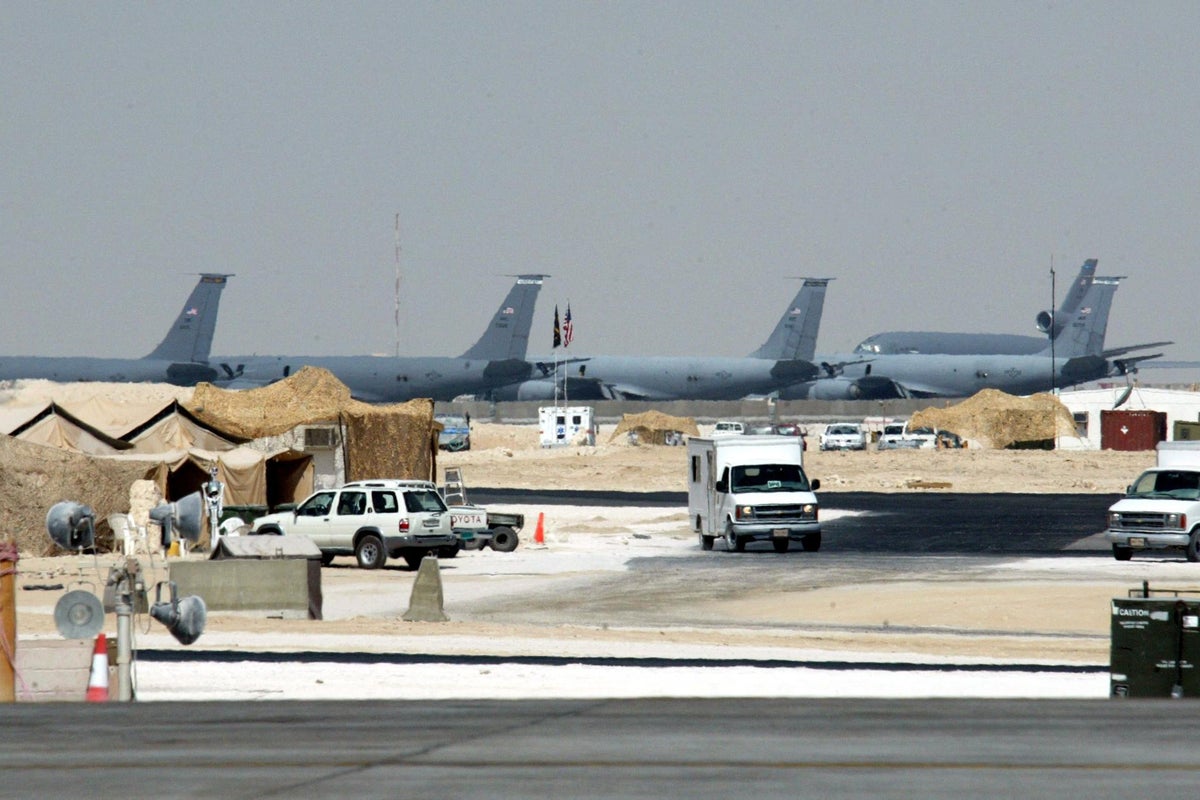
The standard map of US and UK military presence in the Middle East is a lie. Not because the dots are in the wrong places—though the Pentagon loves a good "undisclosed location" moniker—but because the maps imply these bases are a shield. They aren't. In the age of low-cost loitering munitions and ballistic saturation, the massive footprint of Centcom is no longer a projection of power. It is a massive, static liability.
Western media outlets love to trot out the "lily pad" strategy every time Tehran rattles the saber. They point to Al-Udeid in Qatar or Tower 22 in Jordan as if these installations are impregnable pieces on a chessboard. They view the geography of the Middle East through a 1991 lens. But the math has changed. The cost of a single Patriot interceptor missile is roughly $4 million. The cost of the Iranian-made Shahed drone it’s shooting down? About $20,000.
You don't need a PhD in logistics to see that the US isn't "containing" anything. It’s being bled dry by an asymmetric math problem.
The Geopolitical Hostage Crisis
We need to stop calling these "strategic assets." A strategic asset provides freedom of maneuver. These bases do the opposite. They tether American foreign policy to the whims of local autocrats and make US personnel convenient targets for every regional proxy looking to score points.
Take Al-Udeid Air Base in Qatar. It’s the crown jewel, housing the Combined Air Operations Center. The consensus view says this is a vital hub for regional stability. The reality? It forces the US into a grotesque diplomatic dance with a host country that simultaneously funds the very groups the US is trying to "stabilize."
Then there’s Bahrain, home to the US Navy's 5th Fleet. It’s a sitting duck. The Persian Gulf is a bathtub, and the 5th Fleet is the rubber ducky. In a full-scale kinetic exchange, the bottleneck of the Strait of Hormuz turns the Gulf into a kill zone. Modern anti-ship cruise missiles (ASCMs) have turned the "blue water" Navy's regional hub into a coastal defense nightmare.
I have spoken with defense contractors who spent decades hardening these sites. They’ll tell you privately what they won't say on cable news: you cannot build a wall high enough to stop a saturation attack. If 500 drones and 100 ballistic missiles are launched simultaneously, the defense grid fails. It’s a statistical certainty.
The Myth of the UK's "Global Britain" Reach
The British presence is even more precarious. HMS Jufair in Bahrain and the "permanent" base in Duqm, Oman, are marketed as evidence of a "Global Britain." It’s theater. The UK’s carrier strike capability is impressive on paper, but without the massive logistics tail of the US, these bases are little more than expensive fuel stations for a fleet that can barely keep its ships at sea.
The UK presence exists primarily to provide a veneer of "coalition" legitimacy to American operations. It’s a diplomatic insurance policy, not a military deterrent. When Iran launched its retaliatory strikes, the UK’s contribution was largely symbolic—interdicting a handful of drones that the US grid was already tracking.
The "Tower 22" Wake-Up Call
The attack on Tower 22 in Jordan should have been the end of the "lily pad" delusion. It wasn't a massive complex; it was a small support base. And it was vulnerable.
The "People Also Ask" sections of the internet want to know: "How many US troops are in the Middle East?" The answer—roughly 30,000 to 45,000—is the wrong metric. The real question is: "How many of these troops can actually defend themselves against a swarm?"
The answer is: fewer than you think.
Military planners are obsessed with "force protection," which is a polite way of saying "trying not to get killed while sitting still." When you spend 90% of your energy on force protection, you aren't conducting a mission. You are the mission. You are there to justify your own existence and the defense contracts required to keep the C-RAMs humming.
Redefining the Map: The End of the Fixed Base
The future isn't a permanent base with a Burger King and a PX. If the US wants to actually project power without being a stationary target, it has to embrace Agile Combat Employment (ACE).
ACE is the antithesis of the "Big Base" philosophy. It’s about being nowhere and everywhere. It’s about landing a C-17 on a highway in the desert, refueling a flight of F-35s, and vanishing before a satellite can even pass over.
But the Pentagon hates this. Why?
- It’s hard. It requires incredible logistics and decentralized command.
- It’s cheap(ish). You can't justify a billion-dollar line item for a "temporary landing strip" the way you can for a massive base in Kuwait.
- It lacks "presence." Politicians love "presence." They love seeing a flag over a permanent gate.
The "lazy consensus" says that pulling out of these bases would create a power vacuum that China or Russia would fill. This ignores the fact that China is currently "filling" the region with infrastructure and trade deals without placing a single combat troop in a contested zone (outside of Djibouti). They are letting the US pay the "security tax" while they reap the economic rewards.
The Brutal Logic of Asymmetry
Imagine a scenario where the US actually shuttered its vulnerable outposts in Iraq and Syria.
The immediate outcry would be that we are "abandoning allies." But look at the data. Our presence in Al-Tanf, Syria, hasn't stopped Iranian influence; it has provided a target for Iranian-backed militias to practice their drone telemetry. By staying, we give our adversaries a dial. They can turn the heat up or down whenever they need leverage in a totally unrelated negotiation.
We are handing them the remote control to our domestic politics. Every time a drone hits a barracks, it’s a headline that pressures the White House.
The High Cost of Staying Put
Let’s talk about Camp Arifjan in Kuwait. It’s a logistics powerhouse. It’s also a massive footprint that requires thousands of personnel just to keep the lights on and the sand out of the machinery.
In a real war—not a "police action" or a "counter-insurgency" (terms we use to feel better about losing)—Arifjan is a bullseye. The geography of the region has been compressed by technology. In the 90s, distance was a defense. Today, the entire Middle East is a "high-threat environment" for any fixed coordinate.
If you can't move, you’re a target. If you’re a target, you’re a liability.
The Actionable Pivot
The US and UK need to stop pretending it’s 1945 and they are garrisoning West Germany. The Middle East doesn't need more "stabilizing" Western boots; it needs a Western policy that isn't dictated by the vulnerability of its own soldiers.
- Evacuate the small outposts. If a base can't defend itself against a saturated drone attack without a carrier strike group nearby, it shouldn't exist.
- Invest in Mobile Logistics. Shift the budget from "base maintenance" to "rapid deployment tech."
- Acknowledge the Math. Stop trading $4M missiles for $20k drones. If the defense costs more than the attack by a factor of 200, you have already lost.
The map of US and UK bases isn't a map of power. It’s a map of the previous century’s mistakes. Every dot on that map is a potential funeral waiting for a $20,000 reason to happen.
Stop looking at the map and start looking at the clock. The era of the permanent Middle Eastern garrison is over; the only question is how many people have to die before the Pentagon admits it.
Withdraw the targets. Now.