The road hums. It is a steady, rhythmic vibration that travels through the soles of your shoes and up into the base of your skull. You do not notice it until it stops.
When you spend your life driving, you build a mental contract with the machine. You believe the glass holds, the steel frame absorbs the kinetic energy, and the engine stays cold. You trust that the world outside is a blurry smear of gray and green, safely partitioned from the soft, fleshy interior of the cabin. But that contract is thin. It is made of tempered glass and pressurized rubber, and it can be dissolved in a microsecond.
Consider the driver we are talking about. An hour before the incident, they were likely thinking about dinner. Maybe a grocery list. Maybe an argument they’d had that morning, a sharp word they wished they hadn’t spoken. The mundane architecture of a life. And then, the physics of reality changed. A shift in friction, a mechanical failure, or a moment of distraction, and suddenly, the car was no longer a vehicle; it was a trap.
When a car becomes a wreck, it stops being a product of engineering and becomes a puzzle of crushing weight and jagged edges. The silence that follows a collision is never truly quiet. It is a ringing sound, the sound of your own blood rushing in your ears. It is the ticking of cooling metal, the hiss of punctured fluids hitting hot exhaust. And then, the smell begins.
It is a distinct, chemical stench. It is the smell of melting plastic, of ionized air, and of something far older and more dangerous. It is the scent of fire.
In the case of this particular accident, the driver was rendered unconscious by the impact. This is a critical detail. When you are awake, you fight. You kick. You claw at the door handle until your fingers bleed. But when you are unconscious, you are a passenger in your own final moments. You are a dead weight in a furnace. The fire does not care that you are not there to witness it. It only knows that it has fuel, and you are currently occupying the space where that fuel lives.
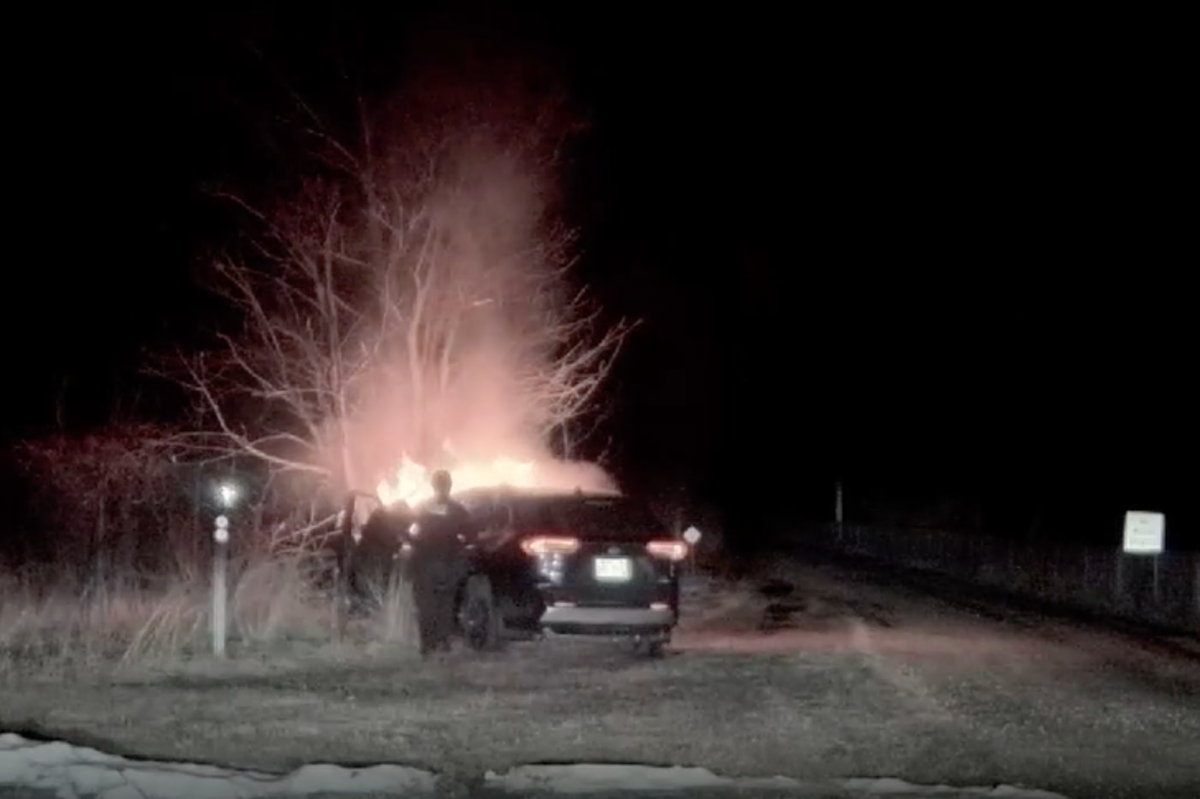
This is where the narrative usually pivots to heroes and villains. We prefer simple stories. We like the idea that rescue is a clean, orchestrated act. But watch the video—if you can bear to look—and you will see the truth. You will see that the police officers involved were not moving with the calculated grace of action stars. They were moving with the frantic, messy, desperate energy of people who knew the clock was running down.
When officers arrive at a burning vehicle, they are not just dealing with the fire. They are dealing with the psychology of containment. A burning car is a localized hell. The heat is not merely warm; it is a physical force that pushes you back. It wants to keep you away. It wants to protect its meal.
To reach inside that car, to pull a body from the wreckage, is to engage in a physical negotiation with the fire.
Think about the mechanics of the rescue. The seatbelt is the first adversary. It is a pretensioned strip of nylon designed to keep you safe in a crash, but in the aftermath of a fire, it becomes a shackle. The officers had to reach through the smoke, through the heat that singed their own uniforms, and find the release. They had to navigate the debris. They had to ignore the warning signs of their own brains, which were screaming at them to retreat, to wait for the fire department, to prioritize their own safety.
They did not.
They treated the unconscious driver not as a victim, but as a piece of cargo that had to be salvaged before the oxygen vanished.
There is a terrifying statistic that we often overlook in our daily commute: the window of survivability in an electrical vehicle fire or a high-impact collision involving fuel lines is often measured in minutes, sometimes seconds. The car becomes a thermal battery. It stores the energy of the crash and releases it as heat.
When you watch these officers, realize that they were operating against the thermodynamics of the scene. They were moving faster than the heat could climb. They were defying the natural progression of the event.
But why does this matter to the rest of us, sitting comfortably at our desks or behind our own steering wheels?
Because we all live with the assumption of safety. We live in a world where we assume that if something goes wrong, the systems will hold. The airbag will deploy. The ambulance will arrive. The police will know what to do. And while that is largely true, we rarely acknowledge that those systems are ultimately just people. Just individuals standing in the heat, making a choice to reach into the dark, tangled metal to pull out someone they have never met.
The rescue of the driver was a reclamation of humanity. In a moment where the machine had failed, where the physics of the world had turned hostile, a human presence stepped in to override the logic of the situation. It was a refusal to let the fire win. It was a stubborn, visceral insistence that a life is worth the risk of a burn, the risk of a lungful of toxic smoke, the risk of a crushing blow from a collapsing frame.
We often talk about the police in the abstract—policy, enforcement, authority. But here, they were stripped of the badge and the car and the radio. They were just people dragging another person toward the cool, clean air.
If there is a lesson to be found in the smoke, it is this: the systems we rely on are only as strong as the people who operate them when the manuals are burned away. When the sensors fail and the technology gives up, when the car is just a hunk of cooling slag on the side of the road, the only thing that separates a tragedy from a survival story is the willingness of a stranger to act.
It forces you to look at the people you pass on the highway differently. That person in the sedan next to you? They are a fragile vessel. They are carrying a history, a future, and an entire internal world that can be snuffed out by a patch of slick oil or a split second of inattention.
We are all driving inside thin, steel shells, moving at speeds that defy our biological evolution, trusting that the road will hold. Mostly, it does. But when it doesn't, we are entirely dependent on the chaotic, unpredictable, and ultimately beautiful nature of human intervention.
The driver was pulled out. They were taken to the hospital. Life, for them, continued. The grocery list still exists. The arguments still need to be resolved. The music they were listening to when the world went dark is still playing somewhere, perhaps, or perhaps it has been replaced by the deafening silence of a second chance.
We often fear the crash. We fear the fire. But perhaps what we should truly fear is the idea that we might become invisible, that we might slip out of the world without someone reaching for us.
The image of that rescue, the silhouette of officers outlined against the orange, flickering light of the flames, is not just a news story. It is a reminder of the contract we have with one another. It is the knowledge that even when the metal buckles and the fire rises, there is a chance—if someone is brave enough—that you will not be left to the mercy of the flames.
The road continues to hum. The cars continue to move. We drive on, shielded by our speed and our routine, rarely acknowledging the thin barrier between where we are and where we might end up. But for one driver, that barrier broke. And in that broken space, they found the only thing that actually matters in the end: someone else’s hand, pulling them back from the edge.
It is a sobering thought. But it is also, in its own jagged way, a comfort.
The fire is extinguished now. The twisted metal has been towed away. The asphalt has been scrubbed clean. But the memory of that heat, that struggle, and that choice remains. It sits in the back of the mind like a stowaway. It asks us to consider what we would do if we were the ones standing in the smoke, and who would be the ones to reach in for us.
It is the weight of the engine, the weight of the steel, and the heavy, undeniable weight of our shared responsibility to one another.
Stay aware of the road, but never forget the people traveling alongside you. Because when the glass shivers and the smoke rises, they are the only thing that will keep you from the dark.
The engine stops. The silence returns. And then, the work of survival begins.