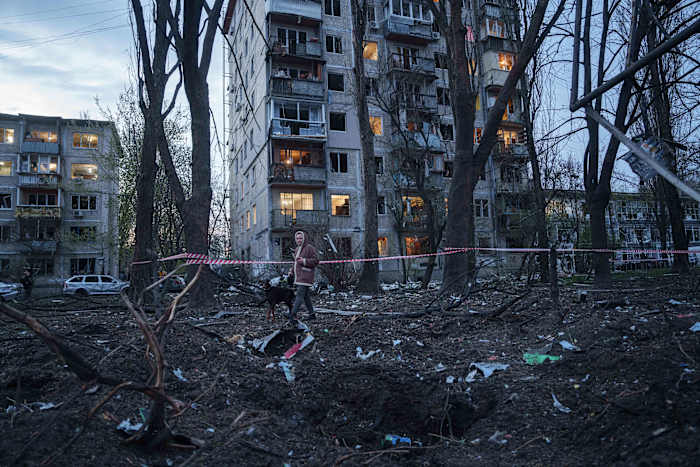
Russia has launched one of its most expansive aerial assaults of the year, deploying a wave of nearly 200 missiles and drones against Ukrainian cities and energy infrastructure. The strikes, which spanned several hours, resulted in at least 16 confirmed deaths and dozens of injuries across regions including Kyiv, Kharkiv, and Lviv. This latest bombardment signals a shift from occasional tactical strikes to a sustained campaign intended to fracture the Ukrainian power grid and degrade civilian morale before the onset of a new seasonal cycle. While Ukrainian air defenses intercepted a significant percentage of the incoming fire, the sheer volume of the attack highlights a growing disparity between Russia's domestic production capacity and Ukraine’s reliance on dwindling Western interceptor stocks.
The Strategy of Saturation
The math behind this latest assault is as cold as it is effective. By launching a mix of low-cost Shahed-type drones alongside sophisticated hypersonic Kinzhal missiles, Russia forces Ukrainian commanders into a lose-lose scenario. They must either expend million-dollar Patriot missiles on $20,000 plastic drones or allow those drones to hit their targets to save the high-end interceptors for the bigger threats. Building on this theme, you can find more in: The Peru Runoff Myth and Why Labels Like Leftist or Far Right Are Geopolitical Dead Ends.
This isn't just about destruction. It is about depletion.
Recent intelligence suggests Russia has significantly ramped up its internal manufacturing of long-range strike capabilities. By setting up massive assembly lines in places like the Alabuga Special Economic Zone, Moscow is no longer just buying from Iran; it is iterating. They are making these drones faster, harder to detect, and more numerous. When 150 drones appear on a radar screen at once, the system is designed to fail. Even a 90% interception rate—which is remarkably high—means 15 projectiles still get through. In a crowded city, 15 hits are a massacre. Analysts at USA Today have shared their thoughts on this matter.
Power as a Weapon of War
The primary target remains the energy sector. We are seeing a move away from hitting small substations toward targeting generation capacity and the massive transformers that are nearly impossible to replace on short notice. If the lights go out, the economy stops. Water pumps fail. Hospitals switch to generators that have limited fuel.
Russia understands that a modern country cannot function without a stable frequency in its grid. By hitting the "nodes" of the Ukrainian energy system, they are attempting to induce a systemic collapse that would render the country uninhabitable for millions, potentially triggering a new wave of refugees into Western Europe. This creates political pressure on NATO allies to force a peace deal on unfavorable terms.
The Technological Arms Race in the Skies
The war has become a laboratory for electronic warfare (EW). Many of the drones shot down in the latest wave showed signs of upgrades intended to bypass GPS jamming. Ukraine has countered by building a nationwide sensor network that uses thousands of microphones to track the sound of drone engines, feeding that data into a real-time map for mobile fire groups.
However, the "How" of this attack reveals a disturbing trend. Russia is increasingly using "decoy" missiles that carry no explosives but mimic the radar signature of a nuclear-capable cruise missile. These decoys draw fire, revealing the locations of Ukrainian air defense batteries. Once a battery fires, its position is compromised, and it becomes a target for a follow-up strike. It is a deadly game of cat and mouse played out in milliseconds over the rooftops of Kyiv.
The Failure of Current Sanctions
Despite the rhetoric from Washington and Brussels, the wreckage of the missiles used in this 16-death toll attack tells a different story. Analysts examining the debris have found microchips manufactured in the West as recently as late 2023. The "shadow fleet" of tankers and a network of front companies in Central Asia and the Middle East ensure that Russia’s military-industrial complex remains fed.
We have to stop pretending that sanctions are a wall. At best, they are a sieve. Russia is paying a premium for components, yes, but they are getting them. The sheer scale of this hourslong attack proves that the Kremlin has solved the logistical hurdles of mass production under international pressure. They are not running out of missiles. They are building them faster than the West is building the defenses to stop them.
The Human Toll and Civilian Resilience
In Kharkiv, the debris of a residential high-rise serves as a grim reminder that "precision" is a relative term in Russian doctrine. When a missile is diverted by electronic jamming, it doesn't just disappear; it falls. It falls on playgrounds, grocery stores, and apartments.
The psychological impact is calculated. Russia wants the Ukrainian public to feel that their government and their allies cannot protect them. Yet, the reaction on the ground remains one of defiant adaptation. Within minutes of the sirens ending, communal workers are out sweeping glass. Power crews are climbing poles while the smoke is still thick. This resilience is a factor Moscow consistently underestimates, but grit alone cannot intercept a ballistic missile.
The Interceptor Gap
The most pressing issue for the Ukrainian military is the looming exhaustion of their air defense magazines. The United States and Europe have provided various systems—IRIS-T, NASAMS, SAMP/T, and the vaunted Patriot. But the global supply of these interceptors is tight. We are seeing a bottleneck where the manufacturing of a single interceptor can take months, while Russia can launch dozens of missiles in a single afternoon.
The West is currently caught in a reactive loop. We provide enough to prevent total defeat, but not enough to secure the skies. This "just enough" strategy is written in the blood of the 16 people killed in this latest barrage. Without a massive surge in both the quantity of launchers and the steady supply of interceptors, these mass-casualty events will become more frequent.
Industrial Realities
Military analysts are now looking at the possibility of "point defense" becoming the only viable option for Ukraine. This would mean abandoning the attempt to protect every city and instead huddling defenses around critical infrastructure and military assets. It is a harrowing choice for any leader. Do you protect the power plant that keeps the heat on for a million people, or the residential district where those people sleep?
Russia's latest strike was a stress test of those very choices. They attacked from multiple vectors—from the Black Sea, from bombers over the Caspian, and from launch sites in occupied Crimea. This forced Ukraine to spread its defenses thin, creating gaps that the drones eventually found.
The sophisticated nature of the coordination—timing the arrival of slow drones with high-speed missiles to arrive at the same target simultaneously—indicates a high level of operational planning that was absent in the early stages of the invasion. Russia has learned from its failures.
The Logic of the Long War
This bombardment is a clear signal that Moscow is prepared for a multi-year conflict of attrition. They are betting that they can outproduce the West's political will. Every time a Russian missile hits a Ukrainian apartment block, it tests the resolve of the international community. Does the world look away, or does it escalate its support?
The reality is that the current level of support is a stalemate. A stalemate in an aerial war favors the side that is willing to target civilians to achieve its ends. Russia has demonstrated that it has no red lines regarding civilian casualties.
Strategic Implications for the Border
The reach of these strikes is also an intimidation tactic aimed at Ukraine's neighbors. Some of the missiles tracked during the attack flew dangerously close to the Polish border, triggering the scrambling of NATO aircraft. This is a deliberate "gray zone" provocation. By pushing the limits of NATO airspace, Russia is gauging the alliance's appetite for direct involvement.
If a stray missile hits a NATO member, the resulting crisis would be unpredictable. Russia is gambling that the fear of that escalation will prevent the West from giving Ukraine the long-range weapons it needs to strike the airfields where these bombers take off. As long as the "sanctuary" of Russian territory remains intact, the missiles will keep coming.
Ukraine is currently fighting with one hand tied behind its back, forced to intercept the arrow rather than taking out the archer. This latest massacre is the predictable result of that constraint. Until the cost for Russia to launch these attacks exceeds the benefit they gain from them, the sirens in Kyiv will continue to wail.
The focus must move toward destroying the launch platforms—the Tu-95 bombers and the Iskander TELs—before they can release their payloads. Anything less is merely managing a tragedy that shows no signs of ending.