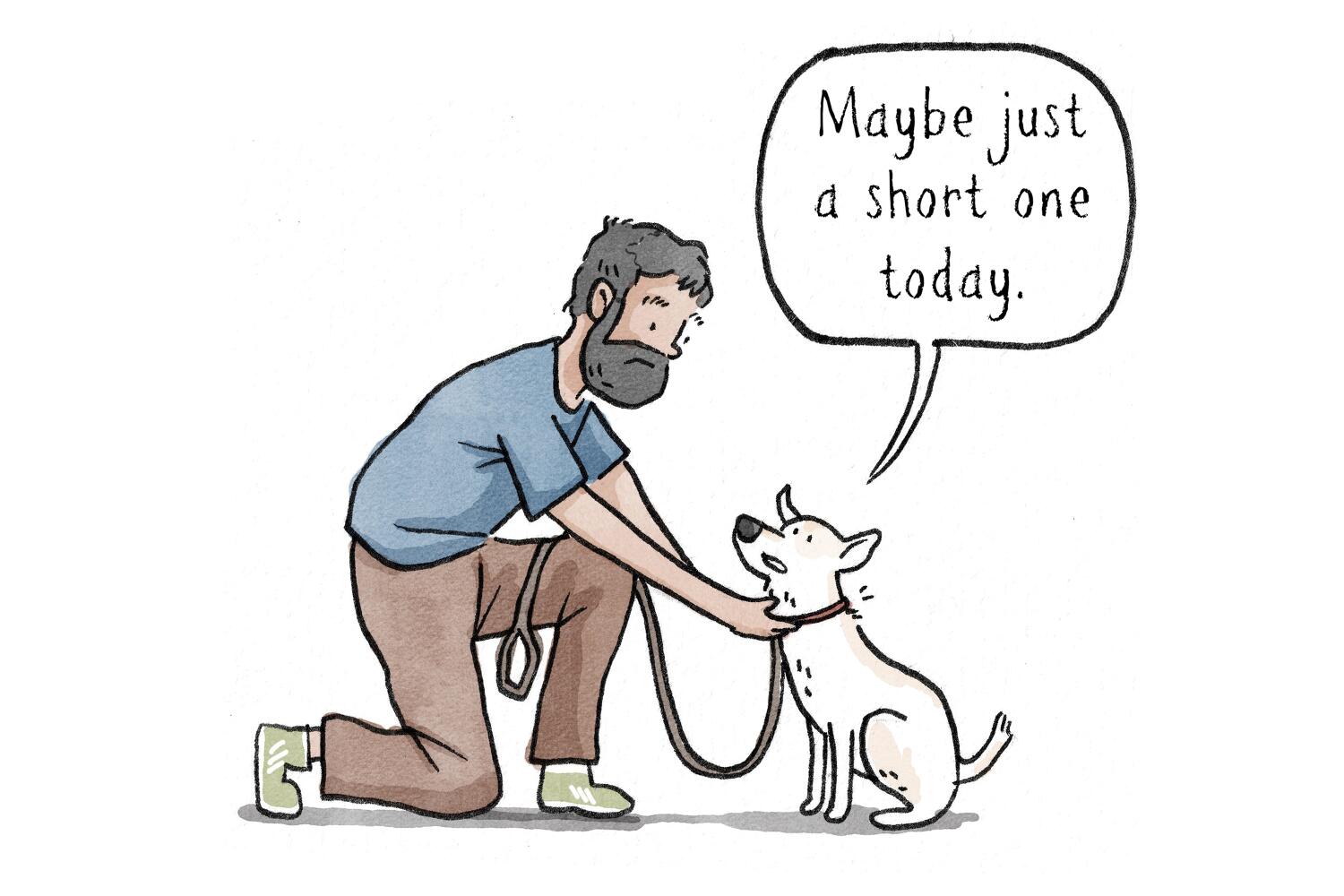
The floorboards groan before he does.
Every morning at six o’clock, I hear the slow, deliberate rhythm of four paws hitting the hardwood downstairs. Click. Click. Drag. Click.
It is a heavy sound, far removed from the frantic, skittering beat that used to echo through this hallway a decade ago. Back then, he was a blurring streak of golden fur and razor-sharp puppy teeth, a creature powered by uncalibrated enthusiasm and zero regard for friction.
Now, he stands at the foot of the bed, waiting.
I lean over the edge to look at him. His muzzle, once as dark as roasted coffee beans, looks as though someone dusted it with powdered sugar. Gray hairs fan out across his chin, creeping up toward eyebrows that have faded from deep amber to soft parchment. His eyes are cloudy around the rims—a gentle, milky haze that veterinarians call nuclear sclerosis, a benign blurring of the lens that comes with the miles.
He stares up at me.
Then, his tail hits the doorframe. Thump.
It is not a polite wag. It is a full-body, sway-backed, ridiculous wiggle that vibrates all the way down his spine. His ears flop forward. His tongue lolls out. In an instant, the thirteen long years written into his joints vanish beneath a surge of pure, unfiltered joy.
He is eighty-four in human years. He is graying, slow, and stiff.
And somehow, he is still entirely a puppy.
The Sugar on the Muzzle
We do not like to think about the mathematics of canine life.
When you bring a puppy home in a cardboard box, the future feels infinite. The days are long, punctuated by chewed shoe soles, housebreaking missteps, and the relentless, joyous chaos of a newborn spirit exploring a giant world. You tell yourself you have plenty of time.
Then you look up, and the kitchen clock has spun thirteen times.
Veterinary data tells us that while small dogs often reach their mid-teens with relative ease, larger breeds cross into seniority around age seven or eight. By thirteen, a medium-to-large dog has traversed roughly eight decades of human biological experience. Their cartilage wears down. Their kidneys work a little harder. Their hearing begins to dim, turning the sharp crack of a dropped pan into a distant, harmless thud.
Yet, the emotional life of an aging dog presents a fascinating paradox that science is only beginning to fully map.
While human aging often brings a retreat from novelty, senior dogs frequently retain their fundamental play drive—the neurological wiring that links playfulness to emotional security and joy. Dr. Alexandra Horowitz, founder of the Barnard College Dog Cognition Lab, has noted that dogs do not measure their lives in retrospection or anticipation. They live in an absolute, crushing present.
They do not look in the mirror and mourn their gray hair. They do not calculate how many autumns they have left.
When a thirteen-year-old dog sees a tennis ball, his brain does not fire a warning about his arthritis. It fires dopamine.
The Art of the Slow Pilgrimage
Our morning walk used to be a training exercise in restraint. I spent years teaching him not to pull on the leash, straining against my shoulder as he tried to reach every squirrel, every fire hydrant, every neighbor on the block.
Today, the leash hangs loose between us like a sagging clothesline.
He walks with a stiff, rolling gait. His back legs do not swing with the effortless spring of his youth; they lift with a deliberate, mechanical care. Veterinary medicine reminds us that up to eighty percent of dogs over eight years old suffer from some degree of osteoarthritis. We treat it with joint supplements, fish oils rich in omega-3 fatty acids, daily anti-inflammatories, and padded orthopedic beds placed in every room so he never has to sleep on a hard surface.
But out on the sidewalk, the pace is entirely his.
A walk is no longer about distance. It is an act of reading.
He stops at the base of an oak tree. His nose twitches—a black, wet engine taking in thousands of chemical signals. He sniffs the grass with the intensity of an archivist examining an ancient manuscript. Who passed by? A stray cat? A neighborhood rival? A breeze carrying the scent of damp earth from three blocks over?
I used to tug the leash when he lingered too long. I was in a rush to get to work, to answer emails, to check off boxes on a list that felt urgently important.
Now, I stand in the cool morning air and wait.
Watching an old dog sniff a patch of grass is a masterclass in presence. He is not worried about tomorrow's vet bill or yesterday's missed rainstorm. He is fully, exquisitely existing in this single square foot of clover.
When he finishes his investigation, he looks up at me, snorts softly, and gives a little hop. Not a big jump—his hips won't allow that anymore—but a tiny, buoyant lift of his front paws. A play bow.
Let's keep going, the bow says. There is still so much to see.
The Physics of a Play Bow
Consider what happens when a squeaky toy enters the room.
For twelve hours a day, he sleeps. He sleeps with the profound, heavy slumber of the elderly, his paws twitching occasionally as he chases phantom rabbits through the meadows of his youth. Sometimes he lets out a quiet, high-pitched yip in his sleep, his muzzle buried in a fleece blanket.
You might think he is fading. You might look at his milky eyes and his hesitant steps on the rug and think the spark is dying down to embers.
Then, you pick up the plush green alligator—the one missing its stuffing, its squeaker long since muted by years of gentle chomping.
You squeak it.
The transformation is instant. Painful joints are forgotten. Gray whiskers perk up. His eyes widen, clearing away the fog of sleep, and his whole body stiffens into a posture of pure alertness.
He drops his front legs low to the rug, his rear end sticking up in the air, tail wagging like a metronome set to double time. He lets out a sharp, joyful bark—a sound far too big for his weathered frame.
He pounces.
It is a clumsy pounce, to be sure. He misjudges the distance by two inches, landing with a soft thud on the rug. But he grabs the alligator, shakes his head with fierce, theatrical ferocity, and struts around the coffee table as if he has just slain a dragon.
This is not regression. It is resilience.
Ethologists call this play retention. In wild canine populations, play is primarily a juvenile behavior used to establish social hierarchies and hone hunting skills. But domesticated dogs—selectively bred over tens of thousands of years for companionship—retain juvenile emotional traits throughout their entire lives, a process known as neoteny.
In an old dog, this neotenic spark is nothing short of miraculous. It is proof that while the physical vessel wears down, the spirit inside remains untouched by the passage of time.
The Invisible Pact
Living with a senior dog breaks your heart in slow motion, yet you would not trade a single second of it.
There are hard days.
There are mornings when he tries to stand up on the hardwood floor and his back legs slip out from under him, sending a shock of confusion through his eyes. You run to him, place your hands under his ribs, and gently lift him until he finds his footing. You buy rubber-backed runners to line every hallway in the house, turning your living space into a patchwork runway just so he can move without fear.
There are nights when he wakes up disoriented, pacing in the dark—a symptom of canine cognitive dysfunction, the dog equivalent of dementia. You sit on the floor beside him in the middle of the night, resting your hand on his side, whispering his name until his breathing slows and he curls back into your lap.
You learn to read his silent language. You know the exact tilt of his head that means he needs water, the subtle shift in his weight that signals he wants help climbing onto the sofa, the quiet sigh that means he is content just to rest his chin on your knee.
It is an intimate, sacred vulnerability.
When we adopt a dog, we make an unwritten pact with time. We accept that we are inviting an intense, unconditional love into our lives, knowing full well that we will likely outlive them. We agree to hold the heavy end of the bargain when the twilight years arrive.
Yet, in return, the senior dog gives us something rare and priceless: a lesson in unconditional devotion that youth simply cannot produce.
A puppy loves you because everything is exciting and you are the center of their chaotic new world.
A thirteen-year-old dog loves you because he knows you.
He knows your voice, your step on the stairs, your smell, your moods, your flaws. He has spent a decade studying the geography of your life. His love is not the frantic, scattershot energy of youth; it is a deep, quiet river that has carved its path into your very soul.
What the Old Dog Teaches Us
We live in a culture obsessed with the new, the fast, the unblemished. We chase youth in bottles, in screens, in endless upgrades. We fear aging because we mistake physical decline for loss of value.
An old dog exposes that fear for the lie it is.
He does not care that his muzzle is silver. He does not care that he can no longer run five miles or jump into the back of the car without a ramp. He measures his worth in simple, unadulterated units of connection: a sunbeam on the carpet, a bowl of warm broth poured over his kibble, a soft hand stroking the soft fur behind his ears.
He reminds us that getting old is not a defeat. It is a privilege.
Every gray hair on his chin is a medal earned for surviving stormy nights, vet visits, moved apartments, and changing years. Every scar is a story. Every stiff step is a testament to thousands of miles walked together in sun, rain, and snow.
When people see us walking down the street, moving at our gentle, measured pace, they often stop to comment.
"He looks like such a sweet old boy," they say softly, reaching out to pat his head.
"He is," I answer.
Then he spots a stray leaf blowing across the asphalt. He tilts his head, lets out a soft ruff, and takes a clumsy, joyful leap after it.
The onlookers laugh, surprised by the sudden flash of puppyhood breaking through the gray mask of age.
I smile, but I am not surprised at all.
I know the secret.
The body grows weary, the eyes grow hazy, and the steps grow slow. But underneath the sugar-dusted muzzle and the tired joints, the puppy never really leaves. He is still there, holding the tennis ball, waiting for you to throw it one more time.