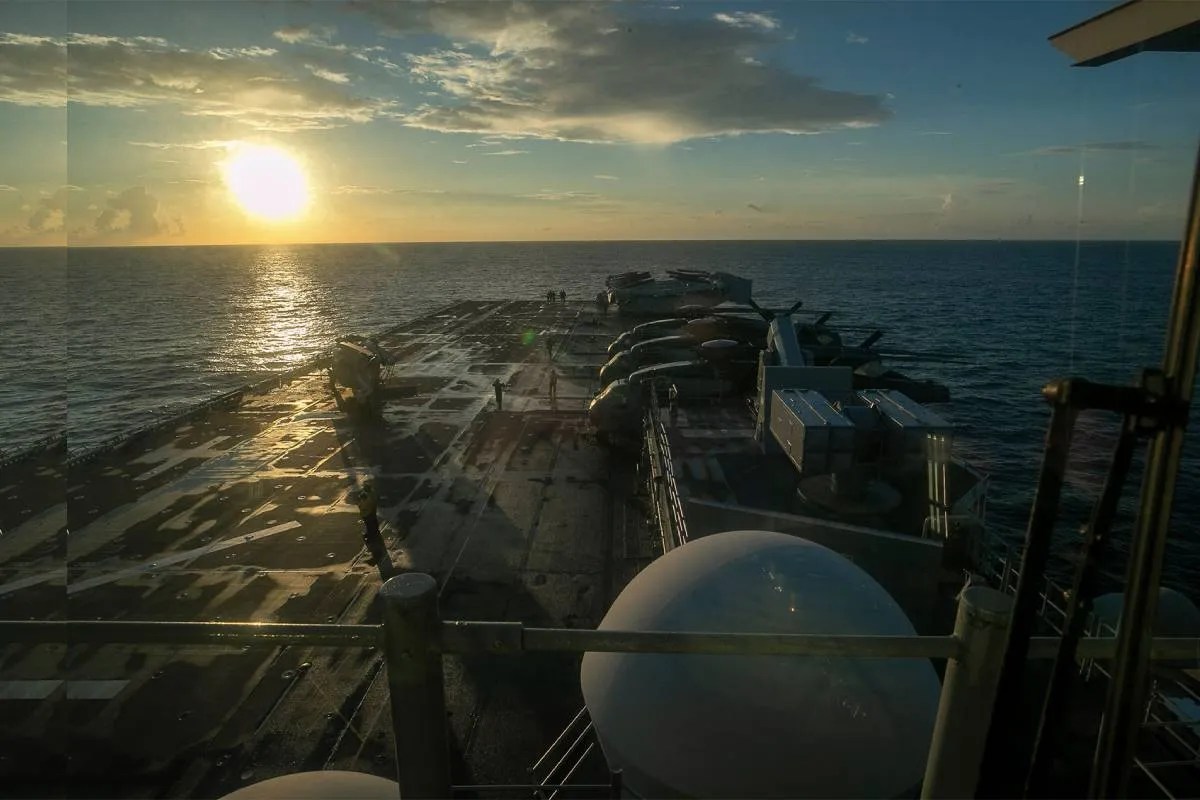
The headlines are screaming about a "Great War" because Iran threatened to sink every US warship if a blockade is enforced. It’s a tired script. Tehran rattles the saber, Washington moves a carrier group, and the media industrial complex prints money off the impending apocalypse. But here is the reality that military analysts whisper behind closed doors: a total US naval blockade of Iran is a logistical fantasy, and Iran’s "swarm" response is a tactical suicide note they have no intention of signing.
We are watching a choreographed dance of ghosts. The "lazy consensus" suggests that we are one spark away from a global shipping collapse. In reality, both sides are terrified of the one thing they claim to want—actual engagement.
The Paper Tiger of the Strait of Hormuz
Every few years, the narrative resurfaces that Iran will "close" the Strait of Hormuz. It sounds terrifying. $20%$ of the world’s petroleum passes through that narrow choke point. The assumption is that Iran can simply park a few ships, drop some mines, and hold the global economy hostage.
It’s a fundamental misunderstanding of modern naval geometry.
Closing the Strait isn’t like closing a garage door. It requires constant, active denial of a body of water that is 21 miles wide at its narrowest point. To actually "close" it, Iran would have to maintain total air and sea superiority against the U.S. Fifth Fleet. I have watched tactical simulations of this exact scenario. Iran can cause a week of chaos. They can spike insurance premiums for tankers. They can even sink a few commercial vessels.
But they cannot hold it. The moment they commit to a full blockade or a mass sinking of US assets, they lose their only leverage: the threat. Once the shooting starts, the US military—which is designed specifically for high-intensity, short-duration kinetic overmatch—dismantles the Iranian coastal defense network in 72 hours. Iran knows this. Their power exists only as long as the "threat" remains a hypothetical.
Why the US Blockade is a Geopolitical Bluff
On the flip side, the idea of a US naval blockade "starving" Iran into submission is equally flawed. A blockade is an act of war. It isn't a "sanction with teeth." It is a physical barrier that requires the boarding and seizing of sovereign vessels from China, India, and Russia.
Does anyone honestly believe the US is going to board a Chinese state-owned supertanker and risk a hot war with Beijing to stop a shipment of Iranian crude?
The "blockade" being discussed in sensationalist media is actually a "maritime interception operation." It’s theater. The US uses it to signal resolve to allies, while Iran uses the reaction to signal strength to its domestic audience. It is a feedback loop of performative aggression.
The Missile Swarm Fallacy
The competitor's article obsesses over Iran’s "swarm" tactics—the idea that hundreds of fast-attack boats and low-cost drones will overwhelm the Aegis Combat System of a US Destroyer.
Let’s talk about the math of the kill chain.
Swarm tactics rely on the "saturate and penetrate" philosophy. If you fire 50 missiles at a target that can only intercept 48, you win. However, this assumes the US Navy is a static target waiting to be hit. It ignores the reality of electronic warfare (EW). In modern naval combat, the most important weapon isn't the missile; it’s the spectrum.
If a US Carrier Strike Group (CSG) goes to "Emissions Control" (EMCON), they become ghosts. Meanwhile, Iranian fast boats rely on terrestrial radar and GPS-linked communications. If the US flips the switch on localized jamming, those "swarms" are blind, deaf, and dumb. They become expensive targets for SH-60 Seahawk helicopters sitting five miles away, picking them off with Hellfire missiles like fish in a barrel.
I’ve seen the data on kinetic vs. non-kinetic defense. People love to count missiles. They forget to count the bits and bytes. A naval engagement in 2026 isn't a repeat of Midway; it’s a high-speed data war where the side with the better signal processing wins before a single shot is fired.
The Economic Suicide Pact
The most overlooked nuance is the internal economic reality of Iran.
Iran’s economy is a brittle machine held together by black-market oil sales and regional influence. A "Great War" doesn't just destroy their navy; it destroys their infrastructure. The Kharg Island terminal, which handles roughly $90%$ of Iran's oil exports, is a fixed target. It cannot move. It cannot hide.
In any "Great War" scenario, Kharg Island ceases to exist in the first four hours.
The Iranian leadership is many things, but they are not suicidal. They are survivors. They have maintained power for decades by mastery of the "gray zone"—the space between peace and war. They use proxies (Houthi, Hezbollah) to do the dirty work because proxies provide deniability.
A direct naval confrontation with the US kills the gray zone. It forces a binary outcome: victory or total regime collapse. Since victory is a mathematical impossibility against the combined weight of US naval aviation and submarine-launched cruise missiles, the regime will never actually push the button.
The China Factor: The Silent Veto
While the US and Iran posture, China is the one holding the leash.
China is Iran's primary customer. China also relies on the stability of global energy prices to fuel its own struggling manufacturing sector. If Iran actually tried to sink "all warships" and cause a global depression, their biggest protector in the UN Security Council would turn on them instantly.
The "sare yuddhapot dubo denge" (we will sink all warships) rhetoric is meant for the street in Tehran and the nationalists in the IRGC. It is not a serious military directive. If an Iranian commander actually tried to execute a mass-sinking of US assets, he would likely be stopped by his own superiors who realize that losing the Chinese trade relationship is a faster death sentence than any US Tomahawk missile.
The Brutal Truth About "Maritime Security"
Most people ask: "Can the US Navy protect the tankers?"
The honest, brutal answer is: Not all of them.
If Iran decides to be a nuisance, they can and will hit a few ships. The ocean is too big to patrol every square inch. But a "blockade" or a "Great War" implies a fundamental shift in the map. That isn't happening.
We are living in an era of Permanent Tension. This isn't a prelude to a storm; the tension is the climate. The US benefits from the tension because it justifies a massive naval presence in the Middle East. Iran benefits because it makes them look like the defiant underdog standing up to the "Great Satan."
Stop waiting for the "Big One." It’s bad for the bottom line of the people who actually run these countries.
Actionable Reality for the Cynical Observer
If you are tracking this for business or geopolitical risk, ignore the "War is Coming" alerts.
- Watch the Insurance Rates: Don't watch the news; watch the Lloyd’s of London Joint War Committee. When they move the Strait of Hormuz into a higher risk category, that’s when the pros think something is actually happening.
- Track the Tanker "Dark Fleet": Iran moves its oil through ships that turn off their transponders. As long as these ships are moving, there is no war. Iran won't fight as long as they can sell.
- Listen for the Silence: The most dangerous moments aren't when Iran is screaming threats. The dangerous moments are when they go quiet. Silence indicates they are actually planning a tactical shift rather than a PR stunt.
The competitor’s article wants you to feel the heat of an explosion. I’m telling you to look at the thermostat. The temperature is being controlled by two actors who are both deathly afraid of the fire.
The US Navy isn't going to be "sunk," and Iran isn't going to be "blockaded" into a 19th-century wasteland. We are stuck in a stalemate of rhetoric where the only casualties are the people who believe the headlines.
The Strait stays open because the alternative is a world where nobody—not Washington, not Tehran, and certainly not Beijing—gets paid. In the end, the ledger is mightier than the sword.