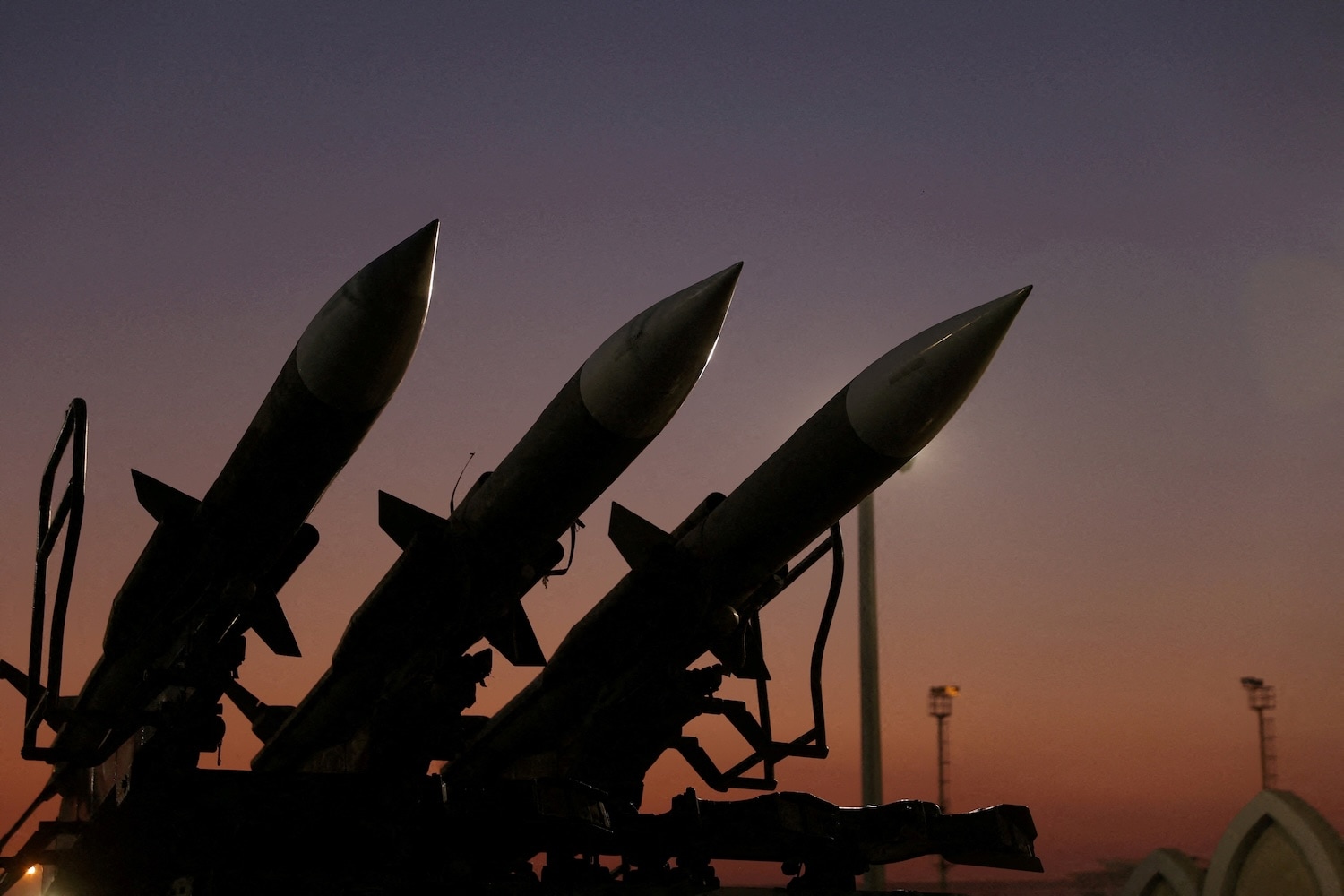
The desert at night is never truly silent. In the vast stretches of Saudi Arabia, where the sand meets the perimeter of a high-alert air base, there is a constant, low-frequency hum. It is the sound of generators, the distant whir of cooling fans for sensitive electronics, and the rhythmic breathing of thousands of soldiers trying to find sleep in a place that feels like the edge of the world.
Then, the hum breaks.
It doesn’t break with a shout or a siren, at least not at first. It breaks with a vibration that travels through the soles of your boots before it ever reaches your ears. It is the signature of physics being pushed to its limit. Somewhere across the border, or perhaps hundreds of miles away in the Iranian highlands, a liquid-fueled engine has roared to life. A ballistic missile is no longer a theoretical threat on a briefing slide. It is a kinetic reality, arching through the thin upper atmosphere, a messenger of steel and high explosives.
When the impact finally comes, it is a sensory overload that defies description.
The Anatomy of a Second
Imagine a room where every object suddenly decides to move at once. The air itself becomes a solid wall. For the U.S. service members stationed at the base, the "Report" of several injuries is a sterile, clinical way to describe what was actually a chaotic struggle for air and orientation. When a ballistic missile strikes, the damage isn't just about the fire or the shrapnel. It is about the pressure.
A blast wave travels faster than the speed of sound. It hits the human body like a physical blow from a giant. It ripples through soft tissue, rattles the brain inside the skull, and collapses lungs. We call these "traumatic brain injuries" in the official tallies. To the corporal who was just reaching for a bottle of water, it feels like the universe just blinked and threw him across a concrete floor.
The statistics will say "several injured." They won't mention the smell of scorched JP-8 fuel or the way the dust hangs in the air, thick and metallic, making every breath a chore. They won't mention the specific, haunting sound of the "Incoming" alarm—a mechanical shriek that lingers in the subconscious long after the sirens have gone quiet.
The Invisible Shield
We live in an era of technological marvels, where we expect the sky to be a ceiling that stays put. On this particular night, the sophisticated radar arrays—the eyes of the base—were locked in a high-stakes chess match with gravity and speed.
Intercepting a ballistic missile is often described as hitting a bullet with another bullet. But that analogy is too simple. It is more like trying to catch a falling star while standing on a moving train, using a glove made of complex algorithms and solid-state sensors.
The "technology" isn't just the hardware. It is the terrifyingly short window of time between detection and impact. You have minutes. Sometimes seconds. In that span, a series of automated decisions are made at speeds no human brain could match. Computers calculate trajectories, predict impact points, and prime interceptors. Yet, as this strike proved, technology is not a god. It is a tool. And tools can be overwhelmed by the sheer volume of a coordinated attack.
The Human Cost of Geopolitics
Why were they there?
It is a question that gets lost in the headlines about regional tensions and strategic pivots. We talk about "assets" and "capabilities," but we rarely talk about the person sitting in the dark of a command trailer, staring at a green glowing screen, wondering if this is the night the luck runs out.
The invisible stakes of a strike like this aren't just found in the broken concrete or the twisted metal of a hangar. They are found in the phone calls home. They are found in the jittery hands of a mechanic who now looks at the clear blue sky with a sense of profound betrayal.
The strike in Saudi Arabia wasn't just a military maneuver. It was a message written in fire. When Iran launches a ballistic missile at a U.S. presence, they aren't just aiming for a fuel depot. They are aiming for the psyche of a superpower. They are testing the resolve of the people who sign up to stand in the gap, thousands of miles from their families, in a desert that holds no love for them.
The Mechanics of the Strike
The report mentions injuries, but it omits the terrifying precision of modern ballistics. Older missiles were "area weapons"—you fired them at a city and hoped you hit something important. Modern Iranian variants, often derived from a blend of domestic innovation and older Soviet or North Korean designs, have become increasingly surgical.
Consider the guidance systems. We are talking about inertial navigation units supplemented by satellite corrections. These missiles can steer themselves during their terminal phase, adjusting their fins to stay on target even as they plummet at several times the speed of sound.
When one of these hits, it isn't a "miss." It is a calculated strike designed to degrade specific capabilities. If a missile hits a barracks, it's a tragedy. If it hits a radar installation, it's a strategic shift. On this night, the injuries sustained were the result of a system that functioned exactly as its creators intended. It found its mark.
The Weight of the Aftermath
Healing from a blast injury is a slow, deceptive process. You might look fine. You might have all your limbs. But the "invisible" injuries—the concussions, the shredded nerves, the hyper-vigilance—stay.
The service members who were injured in this strike are now part of a growing fraternity of soldiers who have felt the percussion of the 21st century's most dangerous game. They are the human data points in a conflict that remains "gray zone"—too hot for peace, but not quite a declared war.
The desert is quiet again now. The smoke has cleared, and the "Report" has been filed, analyzed, and digitized. The hum of the generators has returned, a steady, mechanical pulse in the dark. But the silence is different now. It is heavier. It is the silence of those who know that the sky isn't a ceiling at all. It's a doorway.
The soldiers go back to work. They patch the holes. They recalibrate the sensors. They wait for the next vibration in the soles of their boots, knowing that in the high-speed math of modern warfare, the human element is always the most fragile variable in the equation.