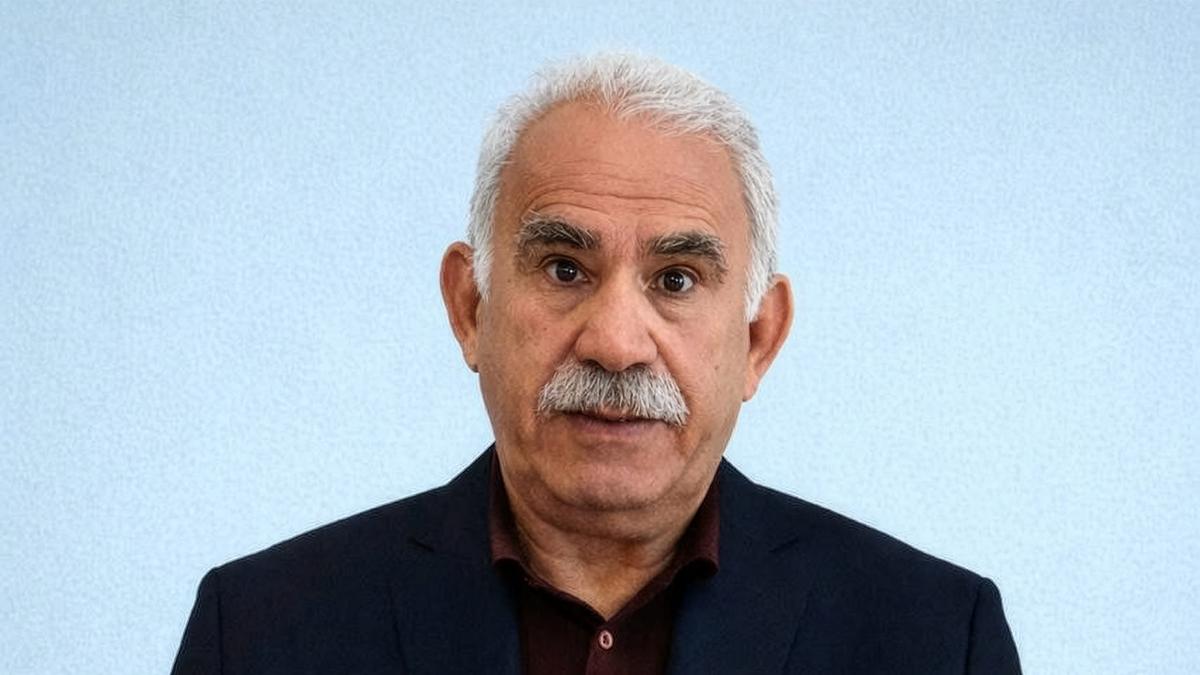
The prevailing narrative regarding the Kurdish issue in Türkiye has hit a dead end, suffocated by the same tired rhetoric of "legal frameworks" and "constitutional guarantees." Abdullah Öcalan’s recent calls for legislative scaffolding to support a peace process aren't just optimistic; they are fundamentally decoupled from the reality of modern governance and power dynamics. We are watching a 20th-century political playbook try to solve a 21st-century crisis of sovereignty.
Everyone is asking the wrong question. They ask, "What laws do we need to pass?" They should be asking, "Why do we think a piece of paper can restrain a state that has spent forty years mastering the art of the 'state of exception'?"
The Legislation Trap
The "lazy consensus" among analysts is that a lack of legal clarity is the primary hurdle to peace. This is a profound misunderstanding of how the Turkish state operates. Laws in Türkiye are not the foundation of order; they are the tools of the prevailing administration. Since the 2016 coup attempt and the subsequent transition to a presidential system, the executive branch has effectively absorbed the legislative's ability to provide a check or a "guarantee."
Proposing "peace laws" in an environment where the judiciary is an extension of the executive is like trying to build a fortress out of wet cardboard. It looks like a structure, but it won't hold under pressure. I’ve watched political movements across the globe—from the FARC negotiations in Colombia to the Good Friday Agreement—fall into this trap. They believe the ink on the page is the victory. It isn't. The victory is the shift in the monopoly on violence, something no one in Ankara or Imrali is actually ready to discuss.
The Myth of the "Legal Guarantee"
Let's dismantle the premise of "legal safety" for those laying down arms. The competitor's view suggests that if the Parliament passes a law, the "deep state" or the nationalist factions will simply shrug and comply. This ignores the historical precedent of the "Solution Process" (2013-2015). During that era, informal understandings were reached, yet the moment the electoral calculus changed, those understandings were incinerated.
A law is only as strong as the institutional appetite to enforce it. Currently, that appetite is zero.
- The Sovereignty Paradox: A state cannot legally negotiate its own territorial integrity without triggering a constitutional crisis that the current nationalist-conservative alliance (AKP-MHP) would use to justify further crackdowns.
- The Bureaucratic Inertia: Even if a law passes, the mid-level security bureaucracy—the colonels and the governors who have built careers on this conflict—will find ten ways to subvert it before the ink is dry.
- The Digital Panopticon: Peace in 2026 isn't about amnesty; it’s about surveillance. The Turkish state’s integration of AI-driven drone tech and SIGINT (Signals Intelligence) means they no longer need "laws" to manage dissent. They have data.
Why Technology Killed the Traditional Peace Process
We are living in the era of the TB2 and the Akinci. The traditional guerrilla warfare model is obsolete, and so is the traditional peace treaty. In the 1990s, a ceasefire meant a physical retreat to the mountains where the state couldn't reach you. Today, there is nowhere the state cannot reach.
This technological asymmetry has changed the math. The state doesn't feel it needs to negotiate from a position of equality. When Öcalan asks for legal steps, he is pleading for a return to a political arena that the Turkish defense industry has effectively deleted. Why would a state with a 24/7 unblinking eye over the Qandil Mountains offer legal concessions when it can simply wait for a sensor hit?
The "Deep State" is now a "Data State"
Critics often point to the "Deep State" as the saboteur of peace. That’s an outdated concept. The new obstacle is the "Data State." The automation of security—biometrics at every checkpoint in the Southeast, social media monitoring, and financial tracking—has created a "frozen conflict" that is more profitable and less risky for the ruling elite than an actual peace.
An actual peace requires the dismantling of the anti-terror apparatus. That apparatus is a multi-billion dollar industry. It’s the engine of the Turkish defense sector, which is the crown jewel of their modern economy. You aren't just asking for a change in the law; you are asking for the liquidation of a massive portion of the national GDP.
The Problem with "People Also Ask" Logic
If you look at the common queries—"Will there be peace in Türkiye?" or "Is the PKK ready to disarm?"—you see the flaw. These questions assume both parties are rational actors looking for a "win-win."
They aren't.
The state is a rational actor looking for total "strategic depth." The PKK leadership is a rational actor looking for survival in a world where their ideological patrons are disappearing. "Peace" is a third variable that neither side actually knows how to manage without losing their core identity.
The Unconventional Reality: Peace as a Software Patch
If we were to actually solve this, we’d stop looking at the Parliament and start looking at the code. Real "guarantees" in the modern age wouldn't be laws; they’d be decentralized protocols.
Imagine a scenario where amnesty and regional autonomy aren't granted by a fickle government, but are hard-coded into the administrative infrastructure of the country. If you can’t trust the judge, you have to trust the system’s architecture. But Türkiye is moving in the opposite direction—centralizing everything into a single point of failure: the Presidency.
The Cost of the "Law First" Strategy
By focusing on legislation, the pro-Kurdish movement is playing a game they’ve already lost. They are asking the dealer for a fair hand while the dealer is busy replacing the cards with digital screens he controls.
- Law creates a target: Any specific "peace law" provides a clear point of attack for the opposition.
- Law is slow: By the time a bill is debated, the geopolitical situation (Syria, Iraq, Iran) has shifted three times.
- Law is reversible: What the Parliament gives, the Parliament (or a decree) can take away.
I've seen this play out in the business world too. Companies try to "regulate" innovation through policy instead of culture. They fail. You can't regulate your way into a new social contract. You have to build the reality until the law is forced to catch up.
The Brutal Truth
The call for "laws" is a performance. It allows the imprisoned leadership to appear relevant and the government to appear like it’s "considering" options while it continues its campaign of attrition.
The only thing that will change the status quo isn't a new statute in the Official Gazette. It’s a fundamental shift in the regional power balance that makes the current cost of war higher than the cost of losing the nationalist vote. Right now, war is cheap and politically profitable. Peace is expensive and politically suicidal.
Stop waiting for a legal miracle. The legal framework isn't the missing piece of the puzzle; it’s the shroud being draped over a dead process.
The real negotiation isn't happening in the halls of Ankara. It’s happening in the drone factories and the currency exchange offices. Until the cost-benefit analysis of the Turkish defense-industrial complex flips, "peace" is just a word used to fill airtime on news cycles.
Build the economic and technological necessity for stability, or keep screaming at a brick wall. The wall doesn't care about your laws.