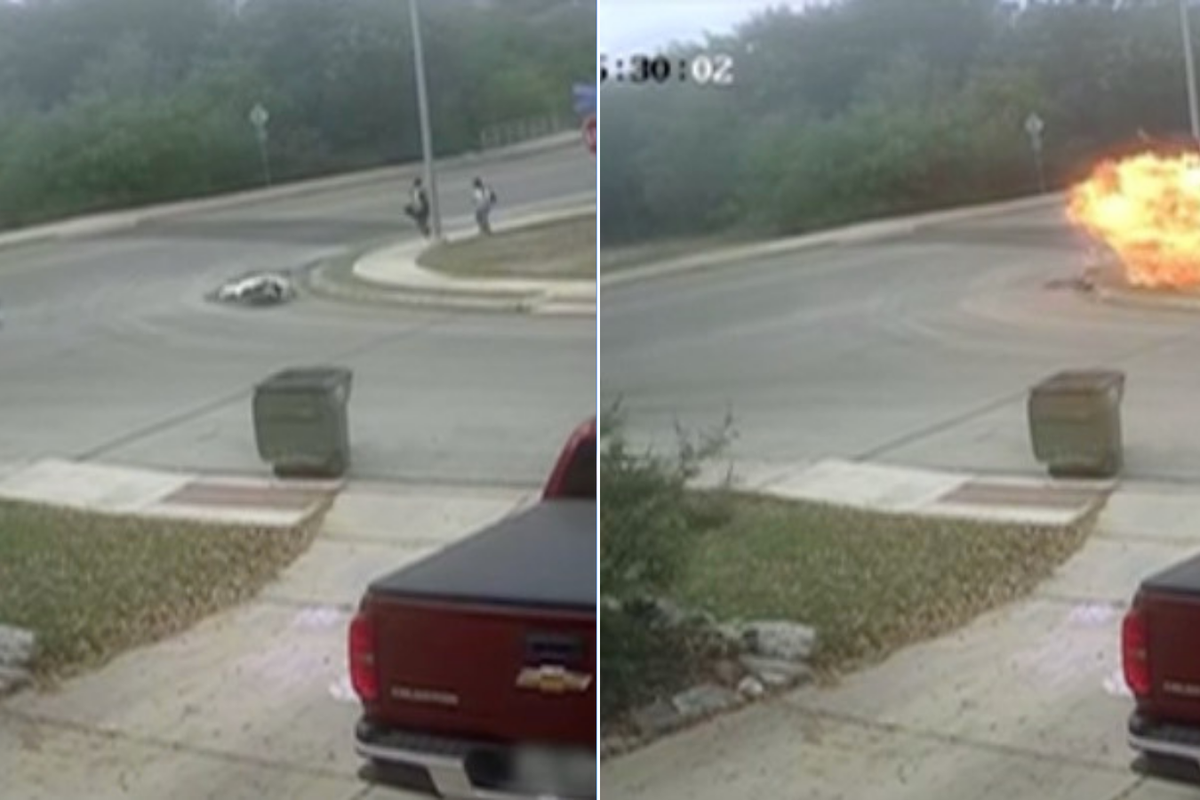
The footage is visceral, the kind of raw digital document that makes a seasoned investigator’s stomach turn. A motorcycle collision, a sudden spray of atomized fuel, and a blossoming orange fireball that swallows a rider and nearby children in a fraction of a second. While the initial reporting focused on the "miracle" of their survival, calling it a stroke of divine luck ignores the mechanical and physical realities that dictated who lived and why the machine failed so spectacularly. These incidents are rarely the result of a single unlucky moment. They are the climax of a sequence where speed, fuel system vulnerability, and the laws of thermodynamics collide.
Survival in these high-thermal events isn't just about luck. It’s about the narrow window between ignition and the arrival of the shockwave or the sustained burn of gasoline. In this specific case, the "miracle" was actually a series of fortunate physical offsets: the direction of the wind, the rapid dispersal of the fuel mist, and the immediate intervention of bystanders who understood that every second spent inside a thermal plume reduces survival rates by orders of magnitude. Recently making waves recently: Stop Treating First Nations Emergencies Like Natural Disasters.
The Anatomy of a Fuel Fed Inferno
Most modern motorcycles are rolling contradictions. They feature advanced electronic rider aids and lean-angle sensitive traction control, yet they still carry several gallons of highly flammable liquid in a container sitting directly above a heat source—the engine. When a bike hits an object or another vehicle at high velocity, the kinetic energy has to go somewhere.
Often, that energy finds the weakest point in the fuel system. This isn't always the tank itself. In many high-impact scenarios, the failure occurs at the fuel pump flange or the quick-disconnect lines. These components are designed for convenience and pressurized flow, not for the massive G-forces of a sudden stop. When a line snaps under pressure, it doesn't just leak. It sprays. Further information into this topic are covered by TIME.
The Science of Atomization
To understand the fireball, you have to understand atomization. Liquid gasoline does not burn; gasoline vapor does. When a fuel tank ruptures during a crash, the liquid is forced through small openings or sheared by the force of the impact. This creates a fine mist.
This mist increases the surface area of the fuel exponentially. A single liter of gasoline, when atomized, can create a massive combustible cloud that requires only a tiny spark—from scraping metal or a hot exhaust header—to ignite. The "explosion" people see isn't a detonation like TNT; it’s a deflagration, a rapid fire spread through a gas-air mixture. Because the children and the rider were on the periphery of this cloud, they escaped the "dead zone" where oxygen is instantly consumed and lungs are seared by superheated air.
Why Some Tanks Hold and Others Explode
There is a growing divide in how manufacturers approach fuel cell integrity. On one hand, you have high-end racing specifications where fuel bladders are reinforced with Kevlar. On the other, you have mass-produced consumer bikes where thin-walled steel or rotomolded plastic is the standard.
Steel tanks offer a certain level of puncture resistance, but they are rigid. When they deform, they can split at the seams. Plastic tanks are more flexible and can often survive a crush without breaking, but they are more susceptible to being sliced by jagged metal from a car’s bumper or a shattered fairing stay. The industry has largely resisted a move toward "crash-survivable" fuel systems seen in aviation because of weight, cost, and the sheer lack of space in a motorcycle's tight packaging.
The Vulnerability of the Filler Cap
One of the most overlooked failure points in these "miracle" crashes is the fuel cap. Many aftermarket caps, chosen for aesthetics or ease of use on the track, lack the robust latching mechanisms of OEM parts. In a tumbling crash, the centrifugal force of the fuel sloshing inside the tank can hit the cap with hundreds of pounds of pressure. If that cap pops, the bike becomes a flamethrower.
Investigation into similar "fireball" incidents frequently reveals that the fuel didn't come from a punctured tank, but from a cap that failed to stay seated. It is a reminder that in the world of high-speed transit, the smallest component can be the difference between a bruised ego and a third-degree burn unit.
The Human Element and the Bystander Effect
We often talk about the "Bystander Effect," where people freeze in the face of a crisis. In this event, that trend was bucked. The survival of the children involved was directly tied to the immediate, non-hesitant action of witnesses.
When a person is caught in a flash fire, the first five seconds are the most critical. The primary threat isn't just the external burn, but the inhalation of fire. Taking a breath in the middle of a fireball can cause internal swelling that closes the airway within minutes. By pulling the victims away from the heat source immediately, bystanders prevented the sustained thermal exposure that leads to fatal outcomes.
Protective Gear vs Thermal Radiation
The rider’s survival is also a testament to the evolution of protective equipment, though it has its limits. Standard leather or high-end textiles like Cordura provide a momentary barrier against flash heat. However, most motorcycle gear is designed for abrasion resistance—sliding on asphalt—not for fireproofing.
There is a common misconception that "all-the-gear, all-the-time" makes you invincible. It doesn't. In a fire, synthetic materials can actually melt into the skin, complicating the injury. The fact that the rider walked away suggests their exposure was limited to the "flash" phase of the fire rather than the "sustained" phase. It is a distinction that trauma surgeons and crash investigators use to determine the severity of an incident before they even see the patient.
The Infrastructure Problem
We cannot look at this crash in a vacuum. The environment where it occurred often plays a silent role in the severity of the outcome. High-friction road surfaces are great for grip, but they increase the likelihood of "spark showers" during a slide. Concrete barriers, while better than oncoming traffic, act as anvils against which a motorcycle is crushed.
In many urban environments, the proximity of pedestrians and children to high-speed lanes creates a "risk corridor." When a bike loses its structural integrity and its fuel system fails, the resulting debris and fire don't stay in the lane. They expand outward, turning a vehicle-to-vehicle accident into a multi-person casualty event.
Rethinking Motorcycle Safety Standards
The industry is currently obsessed with "active" safety—radar-guided cruise control and automatic braking. While these are impressive, they do nothing once the collision is inevitable. We are seeing a plateau in "passive" safety.
There is a strong argument for mandatory fuel-cutoff valves that are triggered by the bike’s Inertial Measurement Unit (IMU). If the bike detects a tip-over or a massive deceleration event, the fuel pump should not just stop—the lines should be instantly depressurized. Some bikes have these features, but they are not universal, and they are often bypassed by owners who modify their machines.
The Aftermath of a Miracle
The media loves a "miracle" because it provides a clean, emotional ending to a terrifying story. But for those in the industry, a miracle is just a data point that didn't end in a funeral. It is a warning.
Every time a bike explodes after a relatively common low-to-mid speed collision, it exposes a gap in our engineering or our regulations. We have accepted the idea that motorcycles are inherently dangerous, which has allowed us to be lazy about certain aspects of their crashworthiness. If a car’s fuel tank exploded in a 40-mph fender bender, there would be a massive recall and a congressional hearing. In the motorcycle world, we just call it a miracle when people survive.
The focus must shift from celebrating the lucky survivors to interrogating the machines that failed them. We need to look at why the fuel escaped, why the ignition source was present, and how we can prevent the next fireball from occurring in a crowded street. Luck is not a safety strategy.
Moving Toward Kinetic Management
The real path forward lies in kinetic management. This means designing motorcycles that don't just protect the rider from the ground, but protect the environment from the motorcycle.
This includes:
- Self-sealing fuel tanks similar to those used in military applications.
- Break-away fuel lines that seal both ends when severed.
- Recessed fuel caps that cannot be knocked open by external impacts.
- Fire-retardant coatings on internal engine components to prevent flash-ignition of spilled fluids.
These technologies exist. They are sitting on the shelves of aerospace firms and racing teams. The barrier to entry isn't the "how," it’s the "how much." Until the consumer or the regulator demands that a motorcycle be as fire-safe as a modern sedan, we will continue to rely on the whims of physics and the bravery of bystanders.
The rider and the children in this incident got a second chance at life, but the machine they were near didn't have a safety net. It did exactly what a poorly protected pressurized fuel system does under stress: it failed. We shouldn't need a miracle to survive a Tuesday afternoon commute. We should be able to rely on the engineering.
Stop looking at the flames and start looking at the fuel lines.