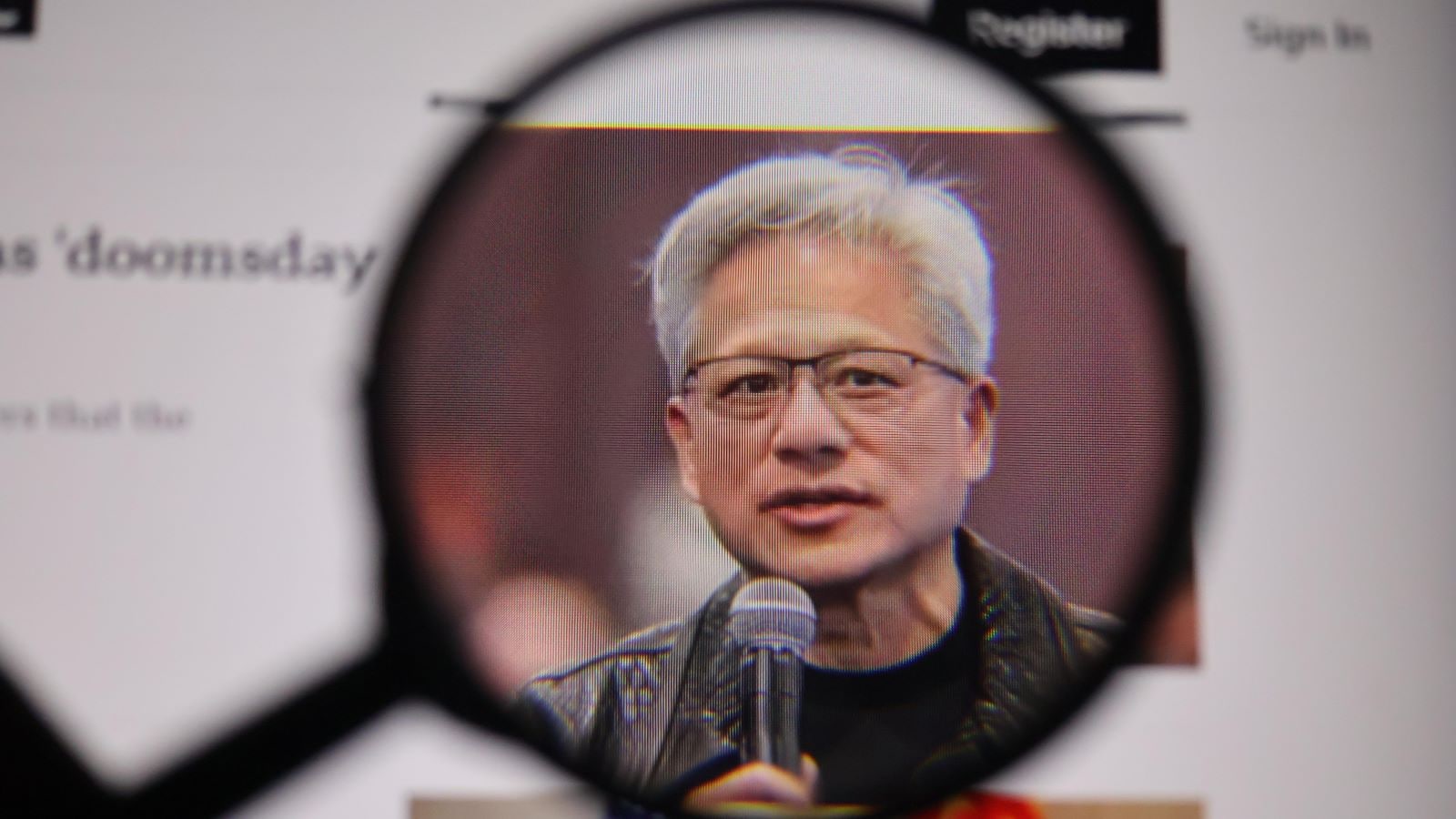
Everyone is debating whether Tim Cook could actually run Nvidia if Donald Trump’s hypothetical suggestion ever gained traction. They are asking the wrong question.
The real issue is not whether Apple’s longtime chief executive is competent enough to sit in the corner office in Santa Clara. Of course he is competent. He built the most profitable supply chain machine in modern corporate history. The issue is that dropping an operations purist into the driver’s seat of an engineering-first pioneer is the fastest way to kill a trillion-dollar juggernaut.
Tech commentators love to treat Fortune 500 CEOs like interchangeable Lego bricks. Take one billionaire-maker out of Cupertino, snap him into Santa Clara, and watch the stock chart keep climbing. That logic ignores fifty years of Silicon Valley history. It confuses supply chain optimization with architectural vision.
If you want to understand why a Tim Cook takeover of Nvidia would stall the AI hardware boom, stop looking at market caps and start looking at how these two companies actually make money.
The Myth of the Universal CEO
Wall Street analysts have a persistent blind spot: they assume management skill is completely fungible. If a leader can take a $350 billion hardware company and turn it into a $3 trillion ecosystem juggernaut, surely they can manage a semiconductor designer riding an artificial intelligence wave.
I have watched boards of directors blow hundreds of millions of dollars on this exact delusion. They hire a peacetime optimizer to run a wartime product company, and within twenty-four months, the engineering pipeline dries up.
Apple and Nvidia operate on fundamentally incompatible operating systems.
Under Tim Cook, Apple perfected the art of the margin-expanding machine. Cook’s genius lies in operational execution, component sourcing, inventory turn velocity, and extracting maximum value from mature product categories. When Steve Jobs handed over the reins in 2011, the core architectural bets—the iPhone, iOS, the App Store—were already on the board. Cook’s mandate was to scale them globally without dropping a single basis point of gross margin. He succeeded beyond anyone’s wildest projections.
Nvidia does not sell mature consumer ecosystems. Nvidia sells pure, unadulterated compute risk.
Jensen Huang built Nvidia by making multi-billion-dollar architectural bets five to ten years before a commercial market existed for them. Look at CUDA (Compute Unified Device Architecture). When Huang decided in 2006 to put programmable shaders and parallel computing software into every single consumer graphics card Nvidia shipped, Wall Street hated it. It bloated die sizes. It crushed gross margins. It solved a problem almost nobody was paying to fix at the time.
An operations-first CEO kills CUDA in the first budget review. You cannot justify burning billions on a proprietary software layer when your core customers just want to play Crysis at higher frame rates. Yet without that reckless, margin-destroying bet in 2006, Nvidia would be a mid-tier gaming component vendor today instead of the backbone of global artificial intelligence.
Supply Chain Mastery vs. Architectural Warfare
To appreciate the friction between Cook’s playbook and Nvidia’s reality, look at how each company treats its manufacturing partners and its product cadence.
Tim Cook famously called inventory "fundamentally evil." His entire career—from IBM to Compaq to Apple—was forged in squeezing suppliers, locking up exclusive manufacturing capacity at TSMC, and driving component costs down by fractions of a penny across hundreds of millions of units. Apple wins by controlling the supply chain so tightly that competitors cannot even buy the same glass, aluminum, or custom silicon at scale.
Nvidia does not win because it buys wafers cheaper than AMD or Intel. Both Nvidia and AMD walk through the exact same front door at TSMC in Taiwan. They pay comparable prices for 4-nanometer and 3-nanometer foundry capacity.
Nvidia wins because of full-stack co-design.
When Nvidia designs a new generation of data center hardware—moving from Hopper to Blackwell to Rubin—it is not just designing a chip. It is designing the interconnects (NVLink), the networking switches (InfiniBand and Spectrum-X), the server racks, the liquid-cooling specifications, and the foundational software libraries (cuDNN, TensorRT) simultaneously.
Consider the difference in how these two organizations make decisions:
- The Apple Model: Define a sleek consumer experience, lock the hardware specifications early, and deploy an army of global supply chain managers to manufacture 200 million identical units with zero defects.
- The Nvidia Model: Compress a two-year hardware roadmap into an annual release cycle, rewrite the low-level compiler stack every six months, and convince hyperscalers like Microsoft, Meta, and Google to spend tens of billions of dollars on infrastructure that did not exist eighteen months ago.
If you put a supply chain genius in charge of Nvidia, their natural instinct is to stabilize the roadmap. Stabilizing the roadmap allows you to negotiate better contracts with memory suppliers like SK Hynix and Micron. It reduces scrap rates on complex packaging like CoWoS (Chip-on-Wafer-on-Substrate). It makes financial forecasting clean and predictable.
It also hands the entire AI market to your competitors on a silver platter.
In enterprise AI infrastructure, predictability is death. The moment Nvidia slows its architectural cadence to optimize packaging yields, Google’s TPUs, Amazon’s Trainium chips, and AMD’s Instinct accelerators catch up. Nvidia’s moat is not its factory efficiency; its moat is that its engineers are already testing the next architecture before customers have even finished unpacking the current one.
The Hidden Flaw in Political CEO Matchmaking
Whenever political figures—whether Donald Trump or anyone else in Washington—float the idea of swapping tech executives to solve national industrial problems, they are viewing corporate leadership through the lens of traditional manufacturing.
In the mid-20th century, moving an executive from Ford to General Motors or from General Electric to Westinghouse made intuitive sense. Those conglomerates ran on capital allocation, labor negotiations, and physical distribution. The underlying physics of building a sedan or a turbine did not change every twelve months.
Modern semiconductor design is closer to theoretical physics combined with high-stakes poker.
Look at what happened when Intel allowed finance and operations executives to take the wheel away from pure silicon architects during the 2010s. Intel’s leadership focused on protecting server CPU margins, maximizing share buybacks, and delaying risky transitions to Extreme Ultraviolet (EUV) lithography to keep short-term capital expenditures looking tidy. By the time Intel realized its foundational process node advantage had evaporated, it was years behind TSMC and completely absent from the GPU compute revolution.
Tim Cook is infinitely sharper than the executives who ran Intel into a ditch, and Apple’s in-house M-series silicon proves Cook knows how to fund world-class chip teams. Let’s be completely honest about that upside. Under Cook, Apple’s Silicon Engineering Group—led by Johny Srouji—built the most power-efficient ARM processors on the planet, humiliating Intel and forcing Apple’s Mac division into a renaissance.
Furthermore, Cook’s geopolitical diplomacy is unmatched in the tech sector. Navigating Washington tariffs, Beijing manufacturing dependencies, and Brussels antitrust regulators requires a level of political tact that few founder-CEOs possess. If Nvidia’s biggest threat over the next decade were strictly export controls and foundry allocation in Taiwan, Cook would be a formidable defensive shield.
Why Defense Does Not Win Silicon Wars
A defensive shield does not build a $3 trillion compute monopoly.
Imagine a scenario where Cook steps into Nvidia’s headquarters tomorrow. Within six months, the company’s operational discipline would tighten dramatically. Gross margins—already sitting above 70 percent—might tick up another point or two. Communication with Washington regulators would become smoother, quieter, and far less prone to public friction.
Then look three years down the road.
Who in that room has the technical authority to tell a team of 5,000 PhD electrical engineers and compiler architects that their current roadmap is wrong, and that the entire company needs to pivot toward a speculative new interconnect standard?
Jensen Huang can do that because he has been sitting in the architectural review meetings since 1993. He reads the technical white papers. He argues over register-transfer-level design and kernel optimization. When Huang tells his organization to bet the company on accelerated computing, the engineers follow him because they know he understands the silicon down to the transistor layer.
Tim Cook does not pretend to be a chip architect. At Apple, his genius was recognizing who the domain masters were—Jony Ive for industrial design, Craig Federighi for software, Johny Srouji for silicon—and building an operational fortress around them so they could execute without friction.
That structure works brilliantly when your core mission is integrating hardware, software, and services into polished consumer devices. It falls apart when your entire company is a single, monolithic technical bet on the future of computing architecture.
What Boards Actually Need to Look For
The fascination with putting Tim Cook at the helm of Nvidia reveals how badly mainstream business commentary misunderstands modern technology leadership. People look at stock performance and assume the magic lives in the CEO’s title rather than the alignment between a leader’s specific obsession and the company’s core bottleneck.
- When a company’s bottleneck is scale, distribution, and margin leakage, hire an operator like Tim Cook.
- When a company’s bottleneck is existential technical obsolescence, keep the founder-architect—or promote a hardcore engineering leader from within.
If you are evaluating any technology company—or deciding where to put your own capital—stop listening to celebrity CEO fantasy drafts. Ask one brutal question: Is this company winning because it executes a known playbook better than anyone else, or because it is inventing the playbook while everyone else is still reading the last edition?
Apple won the smartphone era by perfecting the playbook. Nvidia owns the AI era because it burns its own playbook every twelve months.
Put an operator in charge of an arsonist’s workshop, and the first thing he will do is put out the fire.
.png?width=2560&name=Google Logo Evolution LM (3).png)