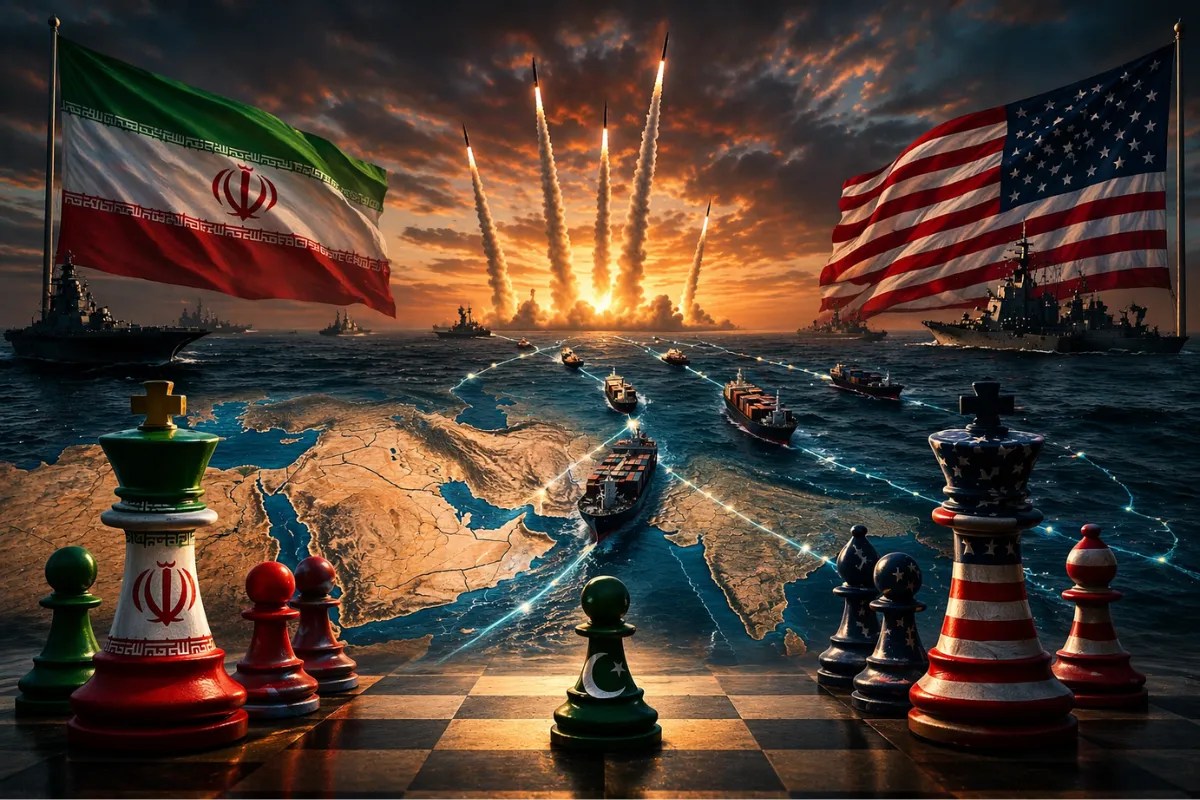
The map in the situational briefing room doesn’t show borders; it shows veins. Red lines of trade and black lines of oil pulse through the Strait of Hormuz and down into the belly of the Arabian Sea. When those veins constrict, the world gasps. Currently, the pressure is mounting.
In the high-walled compounds of Islamabad, the air is thick with the scent of jasmine and the metallic tang of high-stakes diplomacy. Pakistan, a nation often portrayed as a perennial debtor or a regional wildcard, has quietly transformed into the fulcrum of a swinging gate. As the fire between Iran and the broader Middle East threatens to jump the fence, the world isn’t just looking at Tehran or Washington. They are looking at a single desk in Pakistan's military headquarters. You might also find this connected story useful: Why Targeting Iran Power Plants is a Strategic Dead End.
General Asim Munir, the Chief of Army Staff, recently sat across from Iranian officials. This wasn't a standard diplomatic exchange of pleasantries. This was a conversation about the edge of a cliff. Iran is threatening to shut down the Red Sea, a move that would effectively place a tourniquet on global commerce. If that happens, the price of your morning coffee, the gasoline in your car, and the stability of half a dozen governments will shift overnight.
The Geography of Anxiety
Imagine a merchant sailor named Elias. He is 400 miles off the coast of Yemen, navigating a container ship loaded with electronics destined for Europe. To Elias, "geopolitical tension" isn't a headline. It is the sound of a drone overhead. It is the sudden, terrifying realization that the water beneath his feet has become a chessboard. As discussed in recent articles by NBC News, the effects are significant.
When Iran speaks of closing the Red Sea, they are speaking to Elias, but they are also testing the resolve of Pakistan. Why? Because Pakistan is the only nuclear-armed neighbor Iran has. It is the bridge between the Persian world and the nuclear-ready reality of South Asia. For decades, Islamabad has played a dangerous game of balance, leaning toward the Saudi petro-dollars one day and the Iranian energy pipelines the next.
Now, the luxury of indecision has vanished.
The Iranian military delegation didn't come to Islamabad to talk about trade routes in a vacuum. They came because they need a buffer. If Israel or the United States decides that the threats to the Red Sea have crossed a line, Iran becomes an island. Pakistan is the only door left unlocked.
The Nuclear Shadow
Numbers tell a story that words often hide. Pakistan’s military budget is a staggering portion of its GDP, a necessity born of its friction with India. But that military isn't just for defense; it’s a diplomatic currency. When the Iranian Chief of Staff meets with Pakistani leadership, he is acknowledging that Pakistan’s "Strategic Depth" is no longer just a military doctrine—it’s a regional insurance policy.
The stakes are invisible but heavy.
If Pakistan leans too far toward Iran, it risks the wrath of the West and the loss of critical IMF lifelines. If it leans too far toward the West, it risks a restive, sectarian-fueled border with a desperate Iran. It is a tightrope walk performed in the dark, with the wind picking up.
Consider the metaphor of the "Great Game." In the 19th century, it was about empires. Today, it’s about bypasses. The China-Pakistan Economic Corridor (CPEC) is meant to be the ultimate bypass, a way to move goods without ever touching the volatile waters of the Middle East. But if the Red Sea closes, CPEC isn't just a project; it becomes the only artery left. This makes Pakistan more than a player. It makes them the house.
The Human Cost of the Ticking Clock
Behind every diplomatic cable is a person whose life depends on the outcome. In the border towns of Balochistan, the "Iran-Pakistan border" isn't a line on a map—it’s a source of flour, fuel, and survival. Smuggling is the local economy. When tensions rise between Tehran and Islamabad, these towns starve.
A hypothetical shopkeeper in Quetta, let's call him Ahmed, watches the news not for political interest, but to see if he can afford to stock his shelves tomorrow. When the Red Sea is threatened, insurance premiums for ships skyrocket. When insurance goes up, the cost of the Chinese-made lightbulbs Ahmed sells goes up. When those prices rise, his neighbors stop buying.
The chain reaction is brutal.
The threat to close the Red Sea is a lever. Iran is pulling it to see who flinches. By positioning Pakistan as a diplomatic hub, Islamabad is trying to ensure that when the lever is pulled, the machine doesn't break. The recent meetings in Tehran and Islamabad suggest a frantic attempt to find a "middle way" that doesn't exist on any current map.
The Invisible Stakes
We often talk about war in terms of missiles and casualties. We rarely talk about it in terms of calories. If the Red Sea closes and the Gulf of Aden becomes a no-go zone, the global supply chain for grain will shatter.
Pakistan understands this better than most. They are a nation that lives on the edge of a wheat crisis. For them, regional peace isn't an idealistic goal; it’s a caloric requirement. The military leadership isn't just protecting borders; they are protecting the ability of 240 million people to eat.
This is the "human-centric" reality of the news. Every time a general shakes hands with a foreign minister, he is weighing the risk of a missile strike against the certainty of a bread riot.
The Shifting Sand
History doesn't repeat, but it certainly rhymes. In 1979, Pakistan was the staging ground for the Cold War's final act in Afghanistan. In 2001, it was the "frontline state" in the War on Terror. In 2026, it has become the "Diplomatic Center" for a potential Third World War in the Middle East.
The difference this time is the agency.
Pakistan is no longer just a proxy. It is an arbiter. By hosting Iranian military leaders while maintaining a backchannel to the Pentagon, Islamabad is exercising a form of "Grey Zone" diplomacy. They are the only ones who can talk to everyone.
But talking is not the same as solving.
The Red Sea threat remains a loaded gun on the table. Iran has shown it is willing to disrupt the global order to ensure its own survival. Pakistan is trying to convince them that the cost of pulling the trigger is higher than the benefit of the threat. It is a psychological war fought with logistics and troop movements.
A Cold Reality
The sun sets over the Margalla Hills, casting long, jagged shadows over the capital city. In the offices of the Inter-Services Intelligence (ISI), the lights stay on. They are tracking the movement of Houthi rebels in Yemen, the patrol patterns of US destroyers, and the shifting rhetoric coming out of Tehran.
There is no "win" here. There is only the avoidance of a total loss.
If the Red Sea closes, the world changes. The era of cheap, globalized goods ends. The "Indo-Pacific" strategy of the West hits a wall of fire. And Pakistan, sitting at the crossroads of the Middle East, Central Asia, and the Subcontinent, will be forced to choose.
Until that moment, they will remain the center of the storm—the quiet, desperate hub of a world trying to remember how to breathe without choking on the fumes of war.
The jasmine is still in bloom, but the scent is being drowned out by the smell of diesel and the cold, hard reality of a world on the brink.
General Munir returns to his office. The phone is ringing. It might be Riyadh. It might be Beijing. It might be the call that changes everything.
The veins on the map continue to pulse, thinner and faster than before.