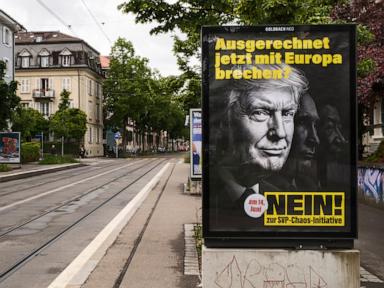
On June 14, Swiss voters will decide whether to legally freeze the nation's permanent population below 10 million residents until 2050, a radical policy proposal that would effectively dismantle the open labor market driving the country's economic model. Spearheaded by the right-wing Swiss People's Party (SVP), the "Sustainability Initiative" has forced a nation built on corporate wealth and foreign talent to confront a uncomfortable question. Can a modern economy survive by putting a hard cap on human capital?
The mechanism of the proposed constitutional amendment operates as a political tripwire. If the permanent population breaches 9.5 million, the federal government must immediately tighten asylum rules and family reunifications. If the population hits the 10 million ceiling, Switzerland will be constitutionally mandated to terminate its bilateral agreement with the European Union (EU) on the free movement of persons.
Currently sitting at 9.1 million residents, the Alpine state is on a rapid demographic trajectory. The population has expanded by nearly two million people since the turn of the millennium. For decades, this influx was viewed as the engine of Swiss prosperity, facilitating a 24% rise in economic output per capita between 2002 and 2024. Now, that same engine is being blamed for gridlocked infrastructure, skyrocketing rents, and the creeping urbanization of the country's celebrated rural landscapes.
The Strategy Behind the Population Cap
The political genius of the SVP initiative lies in its framing. Historically, anti-immigration campaigns in Europe have relied heavily on cultural preservation and nationalist rhetoric. The SVP has pivotally shifted the battleground to environmentalism and quality of life. By branding the population cap as a sustainability measure, campaigners have successfully courted urban, ecologically minded moderates who would typically reject far-right politics.
The core argument targets the visible strains of a growing society. Trains are crowded, housing vacancies in major hubs like Zurich and Geneva have hovered near zero, and the Central Plateau is rapidly turning into a contiguous suburban sprawl. Campaign materials depict paved-over green spaces and concrete blocks encroaching on Alpine valleys.
This narrative taps into a very real domestic anxiety. However, it strategically ignores the policy choices that exacerbated these pressures. The SVP has consistently championed low-tax environments that attract multinational corporations and wealthy expatriates, while simultaneously opposing large-scale public investment in affordable housing and tenant protections. The crisis of infrastructure is not merely a crisis of numbers. It is a crisis of planning.
The Economic Self Correction Myth
Opponents of the initiative, which include the governing Federal Council, mainstream political parties, and the Swiss business federation Economiesuisse, warn of catastrophic economic fallout. They argue that a hard cap on population is a blunt instrument that completely misunderstands how a high-value-added economy functions.
Switzerland does not compete on cheap labor or raw materials. Its dominance relies on fields like pharmaceuticals, precision engineering, luxury goods, and financial services. These sectors require highly specialized, globally sourced talent.
Consider a hypothetical Swiss biotech startup developing a new oncology treatment. If the firm cannot recruit a specific computational biologist from Germany or an immunologist from France because the national population quota is full, the research halts. The company does not simply hire an unqualified local worker. It relocates the entire R&D department to Boston or Singapore.
The labor shortage is already acute. As the baby-boomer generation retires, the gap between workers leaving the market and young citizens entering it is widening. The Swiss Federal Statistical Office estimates that without sustained immigration, the workforce will contract sharply, suffocating the tax base required to fund the country's pension system.
The Guillotine Clause and the EU Dilemma
The most immediate danger of the initiative is not domestic labor shortages, but the geopolitical fallout with Brussels. The EU is Switzerland's largest trading partner, accounting for roughly 60% of its total goods trade.
Relations are governed by a complex web of sectoral treaties known as the Bilateral Agreements I. Crucially, these treaties are bound by a "guillotine clause." If Switzerland terminates one agreement, specifically the free movement of persons, the entire package of treaties automatically becomes null and void within two years.
Terminating these agreements would instantly strip Swiss companies of their preferential access to the European Single Market. It would also jeopardize Switzerland's participation in the Schengen and Dublin agreements, dismantling cross-border security cooperation and upending the country's asylum processing system.
The timing of the vote is particularly volatile. Berne and Brussels have spent months negotiating an updated package of bilateral treaties meant to stabilize their long-term relationship. A "yes" vote on June 14 would instantly blow up these delicate diplomatic efforts, plunging Swiss foreign policy into a period of deep uncertainty at a time when global trade is already fragmented by rising tariffs and geopolitical friction.
A Nation Split by Direct Democracy
Recent polling indicates a dead heat. While initial surveys showed a comfortable majority in favor of the population cap, opposition has steadily risen above 50% as the economic reality of the "guillotine clause" became clearer to pragmatic voters.
Yet, the race remains highly unpredictable. Under the Swiss system of direct democracy, a popular initiative requires a double majority to pass. It must win both the popular vote nationwide and a majority of the 26 cantons. This system structurally favors rural, conservative cantons where anti-immigration sentiment runs high, even if the total population vote leans toward a "no."
The debate has exposed a deep rift in the Swiss psyche. On one side is the desire to preserve an idealized, pastoral version of Switzerland, insulated from the chaotic growth of Western Europe. On the other is the realization that the country's legendary wealth is entirely dependent on its integration into the global economy.
A hard cap on human beings treats a symptom while aggressively killing the patient. If Swiss voters choose isolation on June 14, they will discover that a nation cannot freeze its population without freezing its future.