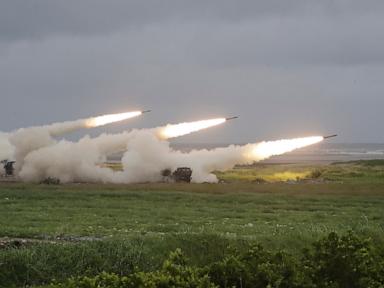
The mainstream media loves a predictable script. Every time Taiwan fires a rocket from a US-supplied High Mobility Artillery Rocket System (HIMARS), the headlines write themselves. They scream about escalating tensions, lines in the sand, and direct warnings sent to Beijing. It is theater. It is a lazy consensus built on a fundamental misunderstanding of modern cross-strait military mechanics.
The truth is much colder, much more mechanical, and entirely unglamorous. Taiwan’s recent live-fire drills using American mobile launching systems are not a show of force directed at the Chinese mainland. They are bureaucratic calibration disguised as geopolitics. Treating these exercises as a psychological warfare victory is a dangerous distraction from the actual, gritty reality of island defense.
The Logistics Illusion
Mainstream analysis operates under the assumption that firing a weapon is inherently an act of deterrence. This views warfare through the lens of a Hollywood trailer. In reality, defense acquisition is governed by strict, unyielding protocols of software integration, crew certification, and supply chain validation.
When a military acquires a new platform like the HIMARS, the primary obstacle is not the enemy. It is the learning curve.
- System Integration: You cannot simply park a US missile launcher on a Taiwanese beach and expect it to communicate with local command-and-control networks. These drills are data-gathering missions to ensure American digital fire-control systems talk to domestic radar arrays without crashing.
- Perishable Skills: Live-fire training is about muscle memory for crews who have spent months staring at simulators. It is about measuring the exact wear and tear on a specific chassis under local humidity and terrain conditions.
I have watched defense analysts lose their minds over the political timing of these launches, completely ignoring the fact that these exercises are scheduled months, sometimes years, in advance based on ammunition shelf-life and fiscal year budget expirations. Beijing knows this. Washington knows this. The only people shocked by the smoke and noise are the pundits.
The Flawed Premise of Mobile Deterrence
The standard narrative insists that mobile launchers give Taiwan a asymmetric edge that terrifies planners in the Eastern Theater Command. The logic goes that because the systems are mobile, they are survivable, and because they are accurate, they keep the People's Liberation Army (PLA) at bay.
This premise is deeply flawed. It underestimates the sheer scale of modern electronic and satellite surveillance.
Imagine a scenario where a conflict begins and a battery of mobile launchers attempts to play a game of hide-and-seek across Taiwan's highly urbanized or densely forested terrain. A vehicle weighing several tons cannot move undetected in an era of ubiquitous synthetic-aperture radar (SAR) satellites that peer through cloud cover day and night.
The Survival Math
Let's look at the brutal arithmetic of a cross-strait engagement.
| System Attribute | Mainstream Perception | Operational Reality |
|---|---|---|
| Mobility | Invulnerable to targeting | Limited by choke points and damaged infrastructure |
| Firepower | Can strike deep into mainland ports | Ammunition capacity is severely constrained |
| Logistics | Easy to resupply via hidden depots | Highly vulnerable during the re-arm cycle |
The bottleneck is never the launcher itself; it is the resupply vehicle. A HIMARS launcher is a useless box of electronics the second it fires its payload. To reload, it must meet a heavy resupply truck at a pre-designated point. This process takes time, requires crane operations, and creates a massive, static thermal signature. In a high-intensity conflict, the reload phase is where mobile artillery dies.
Dismantling the Deep Strike Myth
Another common misconception is that these US-supplied systems allow Taiwan to strike targets deep within the Chinese mainland, thereby changing the strategic calculus. This completely misinterprets the strategic doctrine of island defense.
Taiwan is not building a force designed to trade blows with a nuclear-armed superpower in a war of attrition across the strait. It cannot win that war. The objective is porcupine defense—making the physical invasion of the island so costly that the attempt is never made.
Using high-end precision guided rockets to hit fixed infrastructure on the mainland is a poor use of limited resources. Every rocket fired at a port facility in Fujian is a rocket not available to hit an amphibious landing craft approaching the beaches of Taoyuan. The drills we see today are useful only if they train forces to destroy moving targets in the water, not static buildings across the sea.
The High Cost of the Wrong Strategy
There is a distinct downside to Taiwan’s reliance on high-profile, expensive American hardware. It creates a false sense of security while draining resources from less glamorous, but far more critical, defense needs.
Large, expensive platforms attract attention. They make for great press releases and reassuring evening news segments. But they also create a centralized target list for an adversary's missile forces.
- The Opportunity Cost: The millions spent acquiring and maintaining a small fleet of specialized mobile launchers could instead fund thousands of low-cost, sea-skimming anti-ship missiles or loitering munitions.
- The Maintenance Trap: Sophisticated foreign hardware requires foreign proprietary parts and technical support. In a blockade scenario, that pipeline dries up instantly.
We are seeing a fixation on prestige optics over grinding attrition capability. A handful of rocket launchers firing into the ocean creates the illusion of readiness while mask-shifting the structural vulnerabilities in stockpiles, basic infantry training, and civilian civil defense infrastructure.
Stop looking at the smoke plumes in the Taiwan Strait and reading them as geopolitical tea leaves. They are not a message to Beijing. They are the expensive, loud sound of a military trying to master its own data links before the clock runs out.