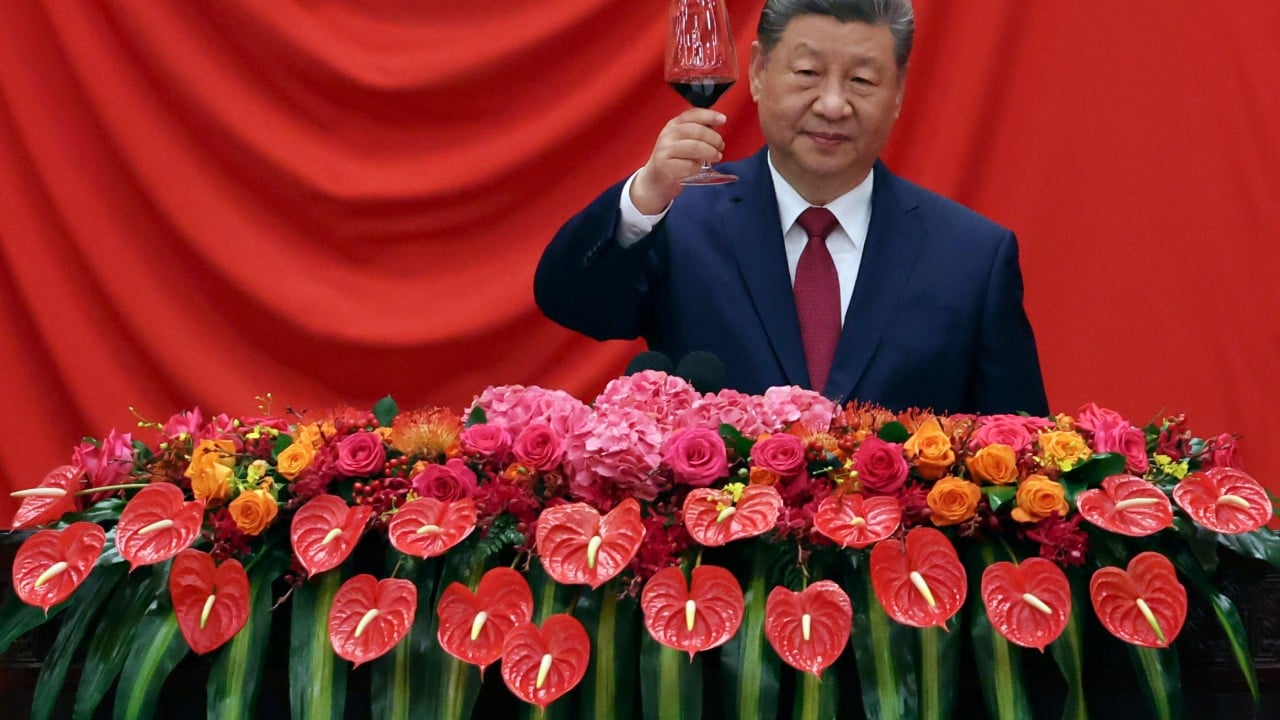
The marble of the Great Hall of the People holds a chill that no central heating can ever quite erase. Thousands sit in unbroken rows, their faces masks of disciplined attention, waiting for the sound that matters more than any stock ticker or diplomatic cable. When Xi Jinping steps up to the microphone, the air in the room shifts. It is not merely the leader of the world's second-largest economy taking his place; it is a signal flare sent across a fractured global map.
National Day is supposed to be a celebration of history. Red banners cascade from balconies, fireworks paint the Beijing sky, and children wave plastic flags. But beneath the pageantry this year lies a heavier pulse. The speech delivered from that grand podium was not just a recital of past glories. It was an urgent, carefully calibrated rallying cry for economic survival and national resurrection.
Consider what a factory floor looks like in Shenzhen right now.
Imagine a middle-aged machinist named Chen. For twenty years, Chen has watched the pulse of global commerce beat through the heavy machinery of his assembly line. He knows the rhythmic thrum of stamping presses like his own heartbeat. But lately, the rhythm has stuttered. Orders from overseas are fluctuating. Whispers of trade barriers, property sector tremors, and shifting supply chains echo through the breakroom. When Chen turns on his television to watch the National Day address, he is not listening for abstract political philosophy. He is listening for a lifeline. He wants to know if tomorrow's paycheck is secure. He wants to know if the grand machine of the state has a plan to keep the lights on in his workshop.
Xi’s address was designed to reach men like Chen.
The core message was unmistakable: confidence. Not the hollow, chest-thumping bravado of a politician with nothing to lose, but the calculated reassurance of a captain steering a massive vessel through a gathering storm. The economy is facing headwinds. Everyone knows it. The real estate slump has bruised consumer confidence, local government debt casts a long shadow, and international skepticism has hardened into policy in Washington and Brussels. Yet, the speech leaned hard into resilience. It invoked the indomitable spirit of reform, signaling that Beijing intends to double down on high-tech manufacturing, green energy, and domestic consumption rather than retreating behind closed doors.
To understand why this matters, step back from the podium and look at the broader board.
Global trade is no longer a smooth highway; it is an obstacle course of tariffs, technological embargoes, and political distrust. When a nation housing 1.4 billion people stumbles, the shockwaves rattle kitchen tables from Berlin to Buenos Aires. China’s economic health is not an isolated domestic affair. It is the engine that drives commodity prices in South America, sustains luxury automotive plants in Germany, and fills container ships crossing the Pacific.
This is why the rhetoric of growth matters so much. Words are currency in geopolitics. When a head of state projects absolute certainty, markets twitch, investors recalibrate, and local officials receive their marching orders. The rallying call for economic growth was a direct command to shake off the paralysis of uncertainty.
Yet, translating a speech into reality is a different beast altogether.
Confidence cannot be manufactured by decree. Down on the ground, local entrepreneurs and private business owners are still calculating risk. They remember the regulatory crackdowns of recent years. They know the scars left by pandemic-era lockdowns. For them, a speech is just music until the actual doors of credit open, until consumer demand rebounds, and until the rules of the game stop shifting beneath their feet.
To bridge that gap between podium rhetoric and factory floor reality, the state is betting heavily on what it calls "new productive forces." Translation: move away from debt-fueled property speculation and plow everything into electric vehicles, solar panels, and advanced semiconductors. It is a high-stakes gamble. By aggressively pivoting toward green tech and automation, Beijing is trying to outpace its own structural problems. But this strategy triggers friction with trade partners abroad, who look at China’s industrial overcapacity and cry foul, erecting new walls to protect their own domestic industries.
So here we stand at the crossroads.
The National Day address was an assertion of will against gravity. It was a declaration that the Chinese economic story is not entering its twilight, but rather its most difficult and crucial chapter. The stakes are staggering. If the growth engine stalls permanently, the social contract that has underpinned decades of unprecedented prosperity begins to fray. If it succeeds, the global balance of power shifts decisively toward a technologically self-reliant Beijing.
Back in Shenzhen, Chen shuts down his machine for the evening. The factory lights blink off one by one. He walks out into the cool autumn air, pulling his jacket tight against the chill. He hasn't solved his mortgage calculations, and the global economy still looks jagged and unpredictable. But as he glances up at the billboards glowing with red National Day crimson, he knows one thing for certain. The people at the top are watching the gauges just as closely as he is. And the race is far from over.