The air inside a G7 summit doesn't smell like history. It smells like expensive wool, industrial-strength espresso, and the faint, metallic tang of filtered HVAC air. There is a specific kind of silence that settles over a room when the men and women holding the literal keys to global solvency realize they are staring into a furnace.
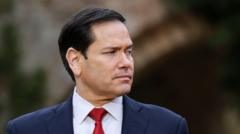
Marco Rubio stepped into that silence this week.
He didn't arrive as a mere tourist of diplomacy. He arrived as the face of a machine that is currently recalibrating its entire internal logic. When the American Secretary of State sits down with his counterparts from London, Paris, and Tokyo, he isn't just swapping talking points. He is managing a pulse. Right now, that pulse is racing. The shadow of a full-scale conflict with Iran has moved from the theoretical whiteboard of a think tank to the very edge of the mahogany table.
Consider a merchant sailor named Elias. He is hypothetical, but his reality is repeated ten thousand times a day on the water. Elias is currently navigating a tanker through the Strait of Hormuz. He doesn't care about the nuances of the Joint Comprehensive Plan of Action. He cares about the fact that his hull is three inches of steel away from a drone strike that could turn the horizon into a wall of fire. If Elias stops moving, your morning commute becomes five dollars more expensive by Tuesday. If a thousand versions of Elias stop moving, the global economy enters a cardiac arrest that no central bank can medicate.
This is the invisible pressure Rubio carried into the room.
The Geography of Anxiety
The headlines will tell you about "coordinated sanctions" and "strategic alignment." They won't tell you about the map. When you look at the Middle East through the eyes of a diplomat, you aren't looking at colors and borders. You are looking at a series of interconnected tripwires.
Iran is not a singular problem. It is a hub. Every move made in Tehran vibrates through the streets of Beirut, the ports of Yemen, and the oil fields of Saudi Arabia. For the G7, the anxiety isn't just about a bomb. It’s about the chaos that follows the fear of a bomb.
The European ministers across from Rubio have a different set of scars than the Americans. They remember the energy crises of the seventies. They see the refugee flows that follow every shattered border. For them, "de-escalation" isn't a soft word; it’s a survival strategy. Rubio’s task was to convince them that strength isn't the opposite of peace—it is the only way to buy it.
He had to bridge a gap that has widened over decades. Washington often views the world as a series of problems to be solved with leverage. Europe often views it as a series of relationships to be managed through patience. Somewhere in the middle, the reality of a looming war sits like an uninvited guest.
The Arithmetic of Escalation
War is rarely a choice made in a vacuum. It is a staircase. You take one step, the other side takes two, and suddenly you are both at a height where neither of you can jump off without breaking your neck.
The G7 talks weren't just about rhetoric. They were about the math of the staircase. Rubio had to present a vision where the cost of Iranian aggression becomes higher than the cost of Iranian cooperation. This requires more than just a stern press release. It requires a total synchronization of the world's most powerful balance sheets.
If the U.S. squeezes the oil, but the rest of the world provides a straw, the pressure fails. If the U.S. threatens force, but the G7 offers a shrug, the deterrent evaporates.
We often think of diplomacy as a polite conversation. It isn't. It is a high-stakes poker game where the chips are the lives of people like Elias and the stability of your retirement account. When Rubio speaks to the Italian Foreign Minister or the German representative, he is asking them to bet their own domestic stability on an American vision of security. That is a massive ask.
Imagine trying to convince your neighbor to help you build a fence to keep out a wolf, knowing that the wolf might bite the neighbor first because they’re closer to the woods. That is the fundamental tension of the G7.
The Human Ghost in the Machine
Behind every policy paper is a person who has to live with the fallout. We talk about "state actors" and "proxies" as if they are chess pieces. They aren't. They are young men in bunkers, mothers in Tel Aviv listening for sirens, and students in Tehran wondering if their future is about to be incinerated.
Rubio’s presence at this summit represents a shift in the American posture. He brings a certain edge, a refusal to accept the status quo of "strategic patience" that has defined the last few years. But that edge has to be tempered. The G7 is a choir, not a solo act. If the American Secretary of State hits a note too sharp, the rest of the group will fall out of tune.
The real story of these meetings isn't the final communique. Those are written by aides weeks in advance. The real story is the body language. It’s the way a hand rests on a shoulder during a coffee break. It’s the look shared between leaders when the doors are closed and the cameras are gone.
In those moments, the "war with Iran" isn't a geopolitical concept. It is a nightmare they are all trying to wake up from.
The Cost of Doing Nothing
There is a tempting logic in isolation. Why does it matter to a baker in Ohio or a coder in Berlin if two ancient powers are posturing in the desert?
It matters because the world is no longer a collection of islands. We are a nervous system. A spark in the Persian Gulf travels at the speed of light through fiber optic cables, hitting the stock exchanges in New York and London before the smoke has even cleared.
If Rubio fails to align the G7, the vacuum is filled by uncertainty. Markets hate uncertainty more than they hate bad news. Uncertainty means higher interest rates. It means frozen credit. It means the small business loan that was supposed to open a new shop never gets approved.
The stakes are not abstract. They are as real as the floor beneath your feet.
The meeting ended, as they always do, with a flurry of motorcades and a flurry of words. But the atmosphere has shifted. The G7 isn't just a club for wealthy nations anymore; it has been forced back into its original role as a war cabinet for the global economy.
Rubio left the room with a set of promises and a mountain of doubts. The "Iran war" remains a headline for now, a looming cloud that hasn't yet burst. But as the delegates flew back to their respective capitals, they carried with them the heavy realization that the staircase is getting shorter.
The furnace is still burning. The only question left is who has the courage to turn down the heat before the room itself begins to melt.
Somewhere in the darkness of the Strait of Hormuz, Elias watches the radar blip. He sees the gray shapes of warships on the horizon. He doesn't know what was said in the air-conditioned rooms of the G7. He only knows that the water is quiet. For now.
But the silence of the sea is never the same as the silence of peace. It is merely the held breath of a world waiting for the next move.
Would you like me to analyze the specific economic triggers that usually precede a shift from diplomatic sanctions to kinetic military action in the Middle East?