Think about the last time you saw a bumblebee buzzing around a flower. You probably viewed it as a tiny, hard-wired biological machine. A miniature robot driven purely by instinct, operating on automated code to find pollen, return to the hive, and repeat until death.
You’re wrong.
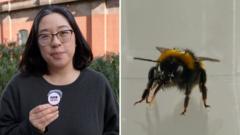
A groundbreaking July 2026 study published in the Proceedings of the National Academy of Sciences has effectively shattered the old assumption that insects are blank slates without a point of view. Researchers at Southern Medical University in Guangzhou, China, alongside neuroethologist Professor Andrew Barron from Macquarie University, decided to look closer at bees than anyone had before. They used slow-motion video to analyze the exact orofacial movements—essentially, facial expressions—of bumblebees (Bombus terrestris) across 18 different colonies.
The results are wild. When a bee tastes something it loves, like a rich sugar solution, it exhibits "post-consumption glossa protrusion." In plain English? It stands there licking its lips long after the food is gone.
When handed something bitter or overly salty, the bee doesn't just stop eating. It shakes its head violently and aggressively wipes its mouth.
This isn't a mere mechanical reflex. It’s an evaluation. For the first time outside of mammals, scientists have documented clear, observable "liking" and "disliking" behaviors that signal a genuine subjective experience.
The End of the Insect Robot Myth
For centuries, science treated invertebrates as little more than clockwork toys. If you poke them, they move. If they smell sugar, they eat. It was assumed their internal world was completely dark.
The 2026 study completely changes that narrative by isolating the bee's reaction from a basic feeding reflex. The researchers discovered that these mouth movements were highly dependent on the bee's internal state, not just the chemical trigger. For instance, a severely dehydrated bee won't shake its head at salty water; it will smack its lips because its body desperately needs it. The reaction is entirely subjective.
Even more fascinating is how the bee brain processes these states. By treating the insects with different neurochemicals, the team altered their behavior. When given an endocannabinoid—a chemical linked to mood and appetite regulation in humans—the bees showed a massive increase in those post-drinking lip-smacking expressions, completely independent of how much sugar was actually in the water.
This proves we aren't looking at an automated reaction. We're looking at a state of mind.
Tiny Brains with Massive Cognitive Power
It is easy to dismiss the idea of an insect having an inner life when you look at the physical hardware. A bee's brain weighs less than a single milligram. It's smaller than a sesame seed. Yet, as renowned bee expert Lars Chittka has demonstrated through decades of research at Queen Mary University of London, efficiency matters far more than size.
Bee brains pack an unbelievable amount of sophisticated processing power into a microscopic space. Consider what an individual bee can actually do:
- Recognize human faces: They can link photos of human features to sugar rewards.
- Count and use tools: They can count landmarks to navigate and have been trained to pull strings or roll balls to get food.
- Learn socially: A bee can sit back, watch a peer solve a complex puzzle, and then mimic the behavior perfectly to get a reward.
- Experience false alarms: When trained to avoid artificial robotic spiders, bees exhibit anxiety-like behavior, Hesitating and scanning safe flowers as if they're imagining threats that aren't there.
This isn't just data processing. It's an active, navigating consciousness.
The Moral Dilemma of Insect Sentience
Now that we know bees possess a basic capacity to feel the world, it forces a massive uncomfortable shift in how we interact with them. If bees can experience a primitive version of pleasure and distress, our ethical responsibilities change completely.
This research lands right in the middle of a growing scientific revolution surrounding insect welfare. We already know that agricultural pesticides like neonicotinoids ravage bee populations, destroying their spatial memory, wrecking their navigation, and slowly killing their nervous systems. But knowing that these creatures might actually be experiencing confusion or distress as their brains fail makes the heavy use of industrial chemicals look even worse.
It also changes the game for laboratory research. Scientists are forced to ask tough questions: Is it ethically acceptable to kill thousands of bees just to see how they tick?
What You Should Do Next
If you want to act on this new understanding of insect life, stop worrying about abstract global policy and start looking at your own backyard.
First, ditch the chemical pesticides completely. If a bee lands on your property, you don't want it bringing toxic nerve agents back to a colony.
Second, plant for variety. Bees are individual learners with distinct personalities. Some are adventurous risk-takers; others are cautious. Providing a diverse mix of native flowers gives these tiny, thinking individuals the sensory environment they actually thrive in.
The old dividing line between "higher" animals that feel and "lower" insects that merely react is gone. The next time a bumblebee buzzes past your face, remember you aren't looking at a bug. You're looking at a creature with an opinion.
The 2026 study on bumblebee facial expressions fundamentally challenges our understanding of animal consciousness, highlighting that a milligram-sized brain can support a genuine inner life. To see these miniature mouth movements and behavioral responses caught on camera, watch Do bees have inner lives? to see firsthand how researchers analyze these tiny, fascinating creatures.