The recoil of a rifle is a physical conversation between the machine and the body. It is a sharp, metallic punch that demands a certain posture—shoulders squared, cheek pressed against the cold stock, breath held in the lungs like a secret. When most ten-year-olds are learning to navigate the social hierarchies of a playground or the frustrations of a math equation, Kim Ju Ae is learning the weight of lead.
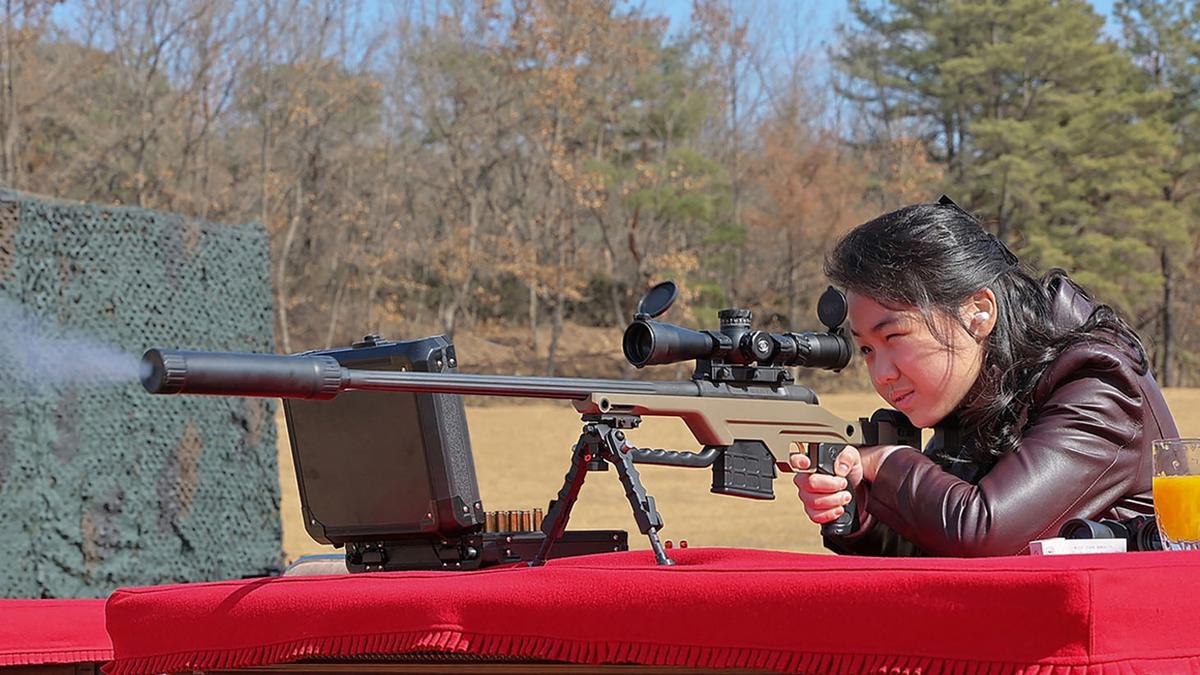
Recent images released by the Korean Central News Agency do not merely show a girl at a firing range. They depict a meticulously choreographed transition. In the photographs, Ju Ae sits beside her father, Kim Jong Un, at a shooting gallery that looks more like a luxury parlor than a military installation. She isn't just watching. She is participating. With a silver-plated rifle—a weapon that looks more like a ceremonial scepter than a tool of war—she takes aim. Meanwhile, you can read other stories here: The Calculated Silence Behind the June Strikes on Iran.
There is a profound, unsettling stillness in the frame. To understand why this matters, we have to look past the grain of the film and into the intent of the stage manager. This is not a candid family outing. In the Hermit Kingdom, the lens is the primary tool of statecraft. Every shadow is deliberate. Every placement of a hand is a paragraph of policy.
The Weight of the Bloodline
The Paektu bloodline is a concept that transcends simple heredity. It is a theological claim to the right to rule, a narrative woven into the very soil of North Korea. For decades, the succession process was shrouded in shadows, whispered about in the corridors of power in Seoul and Washington, only revealed when the predecessor was nearing the end. To see the full picture, we recommend the detailed analysis by NPR.
Kim Jong Un has shattered that tradition.
By bringing Ju Ae into the light so early, he is doing something more radical than just naming a successor. He is normalizing her. He is weaving her presence into the daily visual diet of the North Korean people. When she stands on a balcony overlooking a sea of goose-stepping soldiers, she is being framed as the inevitable. When she holds a rifle, she is being framed as the protector.
Consider the sensory reality of that moment at the range. The smell of burnt cordite. The ringing in the ears. The heavy, velvet silence that follows a gunshot. For Ju Ae, these are not anomalies. They are the background noise of her childhood. While the world debates the geopolitical implications of her "Morning Star" title, the human reality is a young girl being molded into a symbol before she has even reached adolescence.
The Scripted Childhood
It is easy to get lost in the "is she or isn't she" debate regarding her status as the heir apparent. But that misses the more immediate psychological theater at play. Every time she appears, she is dressed in a manner that mimics her father’s aesthetic—dark trench coats, fur collars, hair styled with a gravity that defies her age.
She is a mirror.
When her father looks at her, he sees his own legacy reflected back, polished and prepared. When the public looks at her, they see the continuity of a regime that prides itself on being eternal. The rifle is the punctuation mark at the end of that sentence. It says that the defense of the revolution is not just a man’s job, nor is it a task for the distant future. It is a family business.
The silver rifle itself is a fascinating artifact. It represents a collision of extreme luxury and extreme violence. In any other context, a child with a firearm is a cause for social services; here, it is a "Game of Thrones" style initiation. It signals that the tools of destruction are her birthright.
The Invisible Stakes
Behind the curated images lies a reality of immense pressure. We often talk about North Korea in terms of throw-weights, kilotons, and ballistic trajectories. We rarely talk about the crushing weight of expectation placed on a single child.
Hypothetically, imagine the interior life of a girl who knows her every movement is being analyzed by satellite imagery and intelligence agencies across the globe. There is no room for a "clumsy" phase. There is no space for rebellion. Her identity is being subsumed by the State in real-time.
The introduction of the rifle into her public persona adds a layer of steel to the "Precious Child" image. Previously, she was seen holding her father's hand at missile launches, a touch of softness against the backdrop of Hwasong-17 boosters. Now, the hand is no longer being held; it is pulling a trigger. The transition from observer to actor is complete.
This shift serves a dual purpose. Internally, it tells the North Korean elite that the line of succession is stable and militarized. Externally, it tells the world that the nuclear program and the ideological stance of the country will not soften with the next generation. If anyone hoped that a younger, perhaps more "modern" leader might emerge, these images are a cold shower.
The Architecture of the Image
The North Korean propaganda machine is perhaps the last great practitioner of monumentalist art. They understand that a single image can outweigh a thousand-page white paper.
In the shooting range photos, the lighting is warm, almost domestic. It suggests a father passing down a hobby to a daughter, much like a parent in rural America might teach a child to hunt. But the scale is different. The targets aren't deer; they are the perceived enemies of a nuclear-armed state.
There is a specific kind of silence that exists in North Korean state media—a void where the "why" should be. We are never told why she is there, only that she is. This creates a sense of mythic inevitability. By the time Ju Ae is an adult, the sight of her commanding a military unit or overseeing a weapons test will not be a shock. It will be the only reality the North Korean people have ever known.
The Echo of the Shot
The sound of a rifle shot doesn't just disappear. In a valley, it echoes, bouncing off the rock faces until it becomes a ghostly version of itself.
The image of Ju Ae with her silver rifle is that echo. It is a sound intended to travel through time, reaching forward into the 2040s and 2050s. It is a signal to the generals in Pyongyang that the future has a face, and that face is familiar. It is a signal to the diplomats in Washington that the "North Korea problem" is not a temporary hurdle to be waited out, but a multi-generational marathon.
We watch her through a glass, darkly. We see the fur collar, the focused eyes, the small finger curved around the metal. We see a girl being taught that power is not something you earn through consensus, but something you exert through ballistics.
The true story isn't about the gun. It’s about the hand. And as that hand grows, the world will be forced to reckon with the person it becomes—a leader who was told, from her very first memories, that the world is a target and she is the one who decides when to fire.
The bullet has already left the chamber. The trajectory is set. All we can do is watch where it lands.