A horrific explosion of violence at Negombo Prison has left 26 people dead, including seven prison officers, and more than 100 others injured. The bloodbath, which began on Sunday and escalated into full-scale combat on Monday, is a devastating manifestation of a rotting corrections system that the state has ignored for decades. While official government reports point to a localized clash between rival drug gangs, the reality is far more insidious. This was not an isolated incident of prisoner unrest. It was the predictable consequence of state-sanctioned overcrowding, deep-seated institutional corruption, and the abdication of basic human rights inside Sri Lanka’s penal institutions.
The violence erupted during breakfast when long-term convicts clashed with temporary detainees. What started as a physical altercation quickly mutated into a siege. Prisoners managed to overpower guards, seize firearms, and scale the facility rooftops, while smoke billowed from the compound and the sound of automatic gunfire echoed through the surrounding neighborhood. Justice Minister Harshana Nanayakkara quickly stepped forward to claim official responsibility for the disaster, recognizing the dead as seven officers and 19 inmates. Yet, taking political responsibility does little to clean up the blood-stained floors of a facility that was holding roughly 1,800 prisoners in a space designed for a fraction of that number.
To understand how Negombo became a slaughterhouse, one must look past the immediate trigger of a gang dispute and inspect the structural failures that make such events inevitable.
The Anatomy of the Negombo Bloodbath
The official narrative spun by the Department of Prisons paints a picture of a sudden, unpredictable clash between two drug trafficking factions. One group allegedly backed ongoing trafficking operations from within the prison walls, while another group opposed them. This explanation is convenient because it shifts the blame entirely onto the criminal element. It ignores how those drug networks managed to establish such total dominance inside a high-security state facility in the first place.
The timeline of the riot reveals a massive breakdown in tactical command. On Sunday, the initial fighting resulted in two inmate fatalities. Instead of immediately locking down the facility, segregating ringleaders, and sweeping the wards for contraband weapons, authorities allowed the tension to simmer overnight. By Monday morning, the prison had transformed into a war zone. Inmates did not just use improvised shanks; they gained access to the prison armory, seizing state-issued firearms and using them against guards and fellow detainees.
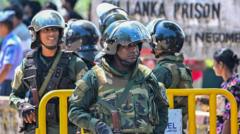
Security forces, including the heavily armed Police Special Task Force, had to be deployed to regain control of the perimeter. Drones hovered above the complex as desperate family members gathered outside the gates, screaming for information while ambulances and police buses transported mangled bodies to Negombo Hospital and Colombo National Hospital. Medical professionals reported that the victims suffered from deep lacerations, severe blunt-force trauma, and military-grade gunshot wounds. The sheer savagery of the injuries indicates that for several hours, the state completely lost the monopoly on violence inside its own walls.
Overcrowding as a Powder Keg
Sri Lanka's penal system operates as an assembly line of human misery. Negombo Prison is structurally incapable of housing 1,800 individuals under humane conditions. When thousands of men are packed into poorly ventilated, unsanitary cells, basic survival instincts take over. The environment strips away human dignity, replacing it with a hyper-aggressive tribalism where alignment with a powerful gang is the only guarantee of safety.
This is a recurring nightmare for the country. In 2020, during the height of the global pandemic, a remarkably similar riot broke out at the Mahara prison, leaving 11 inmates dead. The underlying cause then was panic over disease transmission in tightly packed cells. Going further back, the 2012 Welikada prison riot ended with 27 inmates dead after a security sweep turned into an execution-style massacre. Each time, investigative committees are formed, politicians express shock, and promises of systemic reform are made. Yet, nothing changes because the political will to fund a humane, functioning justice system does not exist.
The issue stems directly from the judiciary's over-reliance on pretrial detention. A vast percentage of the individuals crammed into Negombo are undertrials—people who have not been convicted of any crime but are forced to languish in maximum-security environments for months, sometimes years, waiting for a court date. By mixing non-violent undertrials with hardened, long-term convicts, the state effectively runs a criminal academy, forcing minor offenders into the arms of the very drug syndicates that orchestrated Monday’s violence.
Cartels and Contraband behind Bars
It is an open secret in Colombo that Sri Lanka’s most powerful drug kingpins run their multi-million-dollar enterprises directly from prison cells. They use smuggled mobile phones, satellite internet, and a network of bribed officials to coordinate shipments, order assassinations, and manage distribution networks across the island. The riot at Negombo was a turf war over these exact mechanics.
Prison guards are notoriously underpaid, overworked, and exposed to immense pressure from organized crime. When a guard's monthly salary can be matched by a single bribe to smuggle a smartphone or a package of heroin into a cell block, the internal security architecture collapses. Inmates did not accidentally stumble upon firearms during the riot; they knew exactly where the weapons were kept, and they faced minimal resistance in acquiring them. There is a high probability that certain elements within the prison staff were actively complicit in allowing the situation to escalate, either out of fear or financial alignment with the cartels.
The state’s response to this internal rot has always been superficial. Transferring three high-profile inmates to the Pallansena Prison Camp after the riot is a cosmetic fix. It merely moves the infection to a different part of the body. Until the government implements biometric security, rigorous external oversight of prison staff, and cell-phone jamming technology that cannot be deactivated by a bribe, the cartels will continue to govern the cell blocks.
The Failure of Institutional Accountability
The tragedy at Negombo highlights a deep crisis of faith in the country's legal institutions. Rights defenders have pointed out for years that the conditions inside Sri Lankan prisons violate international standards, including the United Nations Nelson Mandela Rules. Yet, these warnings are routinely dismissed by an administration that prefers a punitive, law-and-order rhetoric to actual structural reform.
True accountability requires an independent, third-party investigation led by judicial figures who are entirely insulated from the Ministry of Justice and the Department of Prisons. The police department cannot be trusted to investigate a disaster where its own tactical units were firing weapons into crowded prison yards. We must also examine the systemic failures of the legal aid system, which fails to provide adequate representation to poor detainees, leaving them trapped in these overcrowded death traps because they cannot afford minor bail amounts.
The 26 lives lost in Negombo are a grim reminder that when a state fails to maintain order and humanity within its corrections system, the violence will eventually spill over the walls. The families of the dead guards and the slaughtered inmates are left demanding answers that the current political establishment is ill-equipped to give. Without an immediate, comprehensive overhaul of sentencing guidelines, infrastructure funding, and anti-corruption measures, the next prison massacre is not a matter of if, but when.
To better understand the scale of the crisis and see the immediate aftermath of the violence, watch this report on the Sri Lanka Prison Riot, which highlights the deployment of special forces and the desperate situation outside the facility gates.