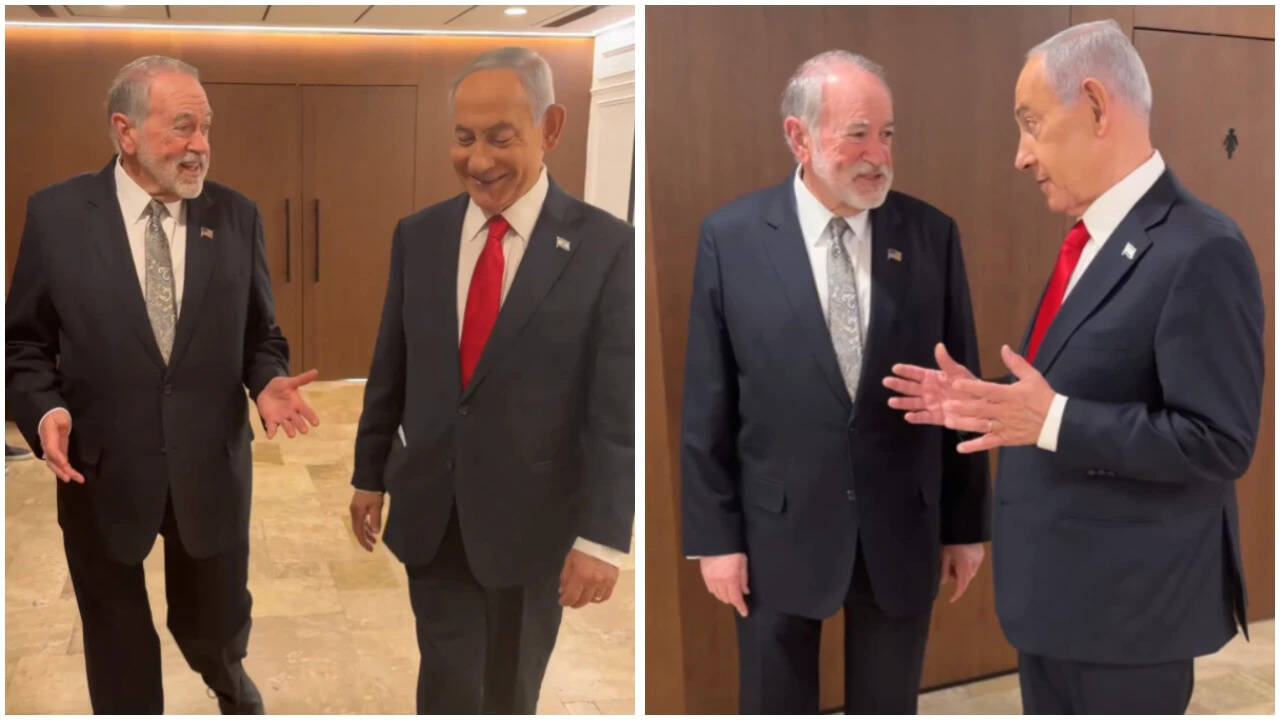
Benjamin Netanyahu’s recent communication to U.S. envoy Amos Hochstein, punctuated by the assertion of being very much "alive" and having "crossed off two names," signals a transition from reactive defense to a high-tempo strategy of leadership decapitation. This is not merely a rhetorical flourish for a domestic audience; it represents a calculated application of the "Degrade and Dismantle" framework intended to reset the regional balance of power through the systematic removal of command-and-control nodes. To understand the current trajectory of the conflict, one must analyze the operational mechanics of these targeted strikes and the strategic vacuum they are designed to create.
The Calculus of Targeted Attrition
Targeted operations function on the principle that non-state and quasi-state military structures are often top-heavy, relying on a narrow cadre of experienced commanders for strategic continuity. When Netanyahu references "crossing off names," he is quantifying the erosion of the adversary’s institutional memory. The effectiveness of this strategy is measured by three primary variables:
- Organizational Paralysis: The time delay between the removal of a leader and the appointment of a successor. During this window, tactical coordination typically falters.
- Intelligence Degradation: High-value targets (HVTs) possess localized knowledge and personal networks that are not easily digitized or transferred. Their removal creates "dark spots" in the organization’s internal communications.
- The Deterrence Premium: The psychological impact on surviving leadership, forcing them into "survival mode," which prioritizes personal security over offensive planning.
This approach assumes that the cost of replacing a sophisticated commander is higher than the cost of the kinetic operation used to remove them. While critics argue that "martyrdom" fuels recruitment, the technical reality is that a new recruit cannot immediately replicate the twenty years of operational experience held by a senior commander.
The Diplomatic Friction Point
The timing of Netanyahu’s statement to the U.S. envoy reveals a fundamental misalignment in geopolitical objectives between Jerusalem and Washington. The U.S. strategy consistently prioritizes "De-escalation through Diplomacy," seeking a return to a status quo that prevents a broader regional conflagration. Conversely, the current Israeli doctrine is "Escalation for De-escalation"—the belief that only by inflicting asymmetric damage can a sustainable long-term deterrent be established.
This friction creates a bottleneck in maritime and border negotiations. By emphasizing his own physical and political survival ("I am alive"), Netanyahu signals to the U.S. that he has the domestic mandate to ignore external pressures for immediate ceasefire if he perceives a tactical advantage in continued strikes. The "two names" mention serves as a proof of concept, demonstrating that intelligence-led operations are yielding tangible results that diplomacy has failed to provide.
The Intelligence-Strike Cycle
The capability to "cross off names" depends on a persistent, high-fidelity intelligence-strike cycle. This process is not a single event but a continuous feedback loop consisting of four distinct phases:
- Pattern-of-Life Analysis: Utilizing signals intelligence (SIGINT) and human intelligence (HUMINT) to map the daily movements of a target.
- Target Validation: Ensuring the individual identified matches the high-value profile and that collateral damage risks meet pre-defined (though often controversial) thresholds.
- Kinetic Execution: The deployment of precision-guided munitions (PGMs) to minimize radius while maximizing lethality against the specific target.
- Bore-Sight Assessment: Post-strike analysis to confirm the identity of the deceased and measure the immediate impact on the adversary's operational tempo.
The mention of two specific names suggests a synchronized operation, likely aimed at a specific geographic sector or functional department (e.g., rocket manufacturing or elite unit command). When multiple nodes are removed simultaneously, the "reconstitution time" for the organization increases exponentially rather than linearly.
Structural Vulnerabilities in Proxy Networks
The strategy of decapitation is particularly potent against proxy networks because these groups often lack the bureaucratic redundancy found in professional state militaries. In a traditional army, a colonel is replaced by a lieutenant colonel through a standardized process. In irregular forces, leadership is often charismatic or based on long-standing personal loyalties.
Removing these figures creates internal friction. The successor must not only prove their tactical competence but also consolidate power among rival factions within the group. This internal power struggle is a feature, not a bug, of the Israeli strategy. It forces the organization to look inward, temporarily halting external operations against Israeli territory.
However, a critical limitation exists. If the underlying ideology and funding (the "Flow of Capital") remain intact, the organization will eventually adapt. Kinetic operations are a time-buying mechanism; they are not a substitute for a political or economic resolution. They lower the "peak capacity" of the adversary but do not eliminate the baseline threat.
The Cost Function of Personal Survival
Netanyahu’s focus on his own survival is a direct response to the perceived erosion of Israeli security on October 7. In the logic of regional power dynamics, the perceived strength of a leader is a proxy for the strength of the state. By framing the conflict as a personal and national survivalist struggle, he aligns his political longevity with the state's security objectives.
This creates a high-stakes environment where "success" is defined by the body count of the opposition’s leadership. The risk in this framework is the "Sunk Cost Fallacy": the temptation to continue kinetic operations past the point of diminishing returns because the political cost of stopping—without a total victory—is too high.
Regional Repercussions and the Proxy Dilemma
The "two names" are likely a signal to the regional patron of these groups. It demonstrates that the "Ring of Fire" strategy—surrounding Israel with hostile proxies—has a vulnerability: the proxies' leadership can be picked off with surgical precision. This forces the patron to decide whether to escalate directly (a high-risk move) or allow their proxies to be systematically weakened.
The operational reality on the ground indicates that Israel has moved beyond the "containment" phase. The current objective is the "attrition of expertise." By targeting the mid-to-upper-level management of hostile groups, Israel is attempting to "reset the clock" on their technological and tactical capabilities.
Strategic Forecast
The focus will now shift to the "Third Name." The momentum of targeted strikes creates a psychological cadence that the Israeli government will feel compelled to maintain. Expect an increase in "deep-state" operations that target procurement officers and financial facilitators, moving beyond just the military commanders.
The primary risk to this strategy is a "Black Swan" event—a strike that results in massive civilian casualties or the death of a target that triggers an uncontrollable escalatory response. To mitigate this, the intelligence-strike cycle will likely become even more localized, utilizing smaller, more precise loitering munitions.
The strategic play is now the transformation of tactical wins into a new diplomatic baseline. Israel is betting that by the time the U.S. or the UN forces a cessation of hostilities, the adversary’s command structure will be so thoroughly hollowed out that it will take a decade to rebuild. The directive is clear: maximize the "crossing off" of names before the diplomatic window closes, ensuring that the post-conflict landscape is defined by an adversary that is disorganized, leaderless, and focused entirely on internal reconstruction rather than external aggression.